What Does an Air Dryer Do in a Compressor System?
What Does an Air Dryer Do in a Compressor System?
Introduction
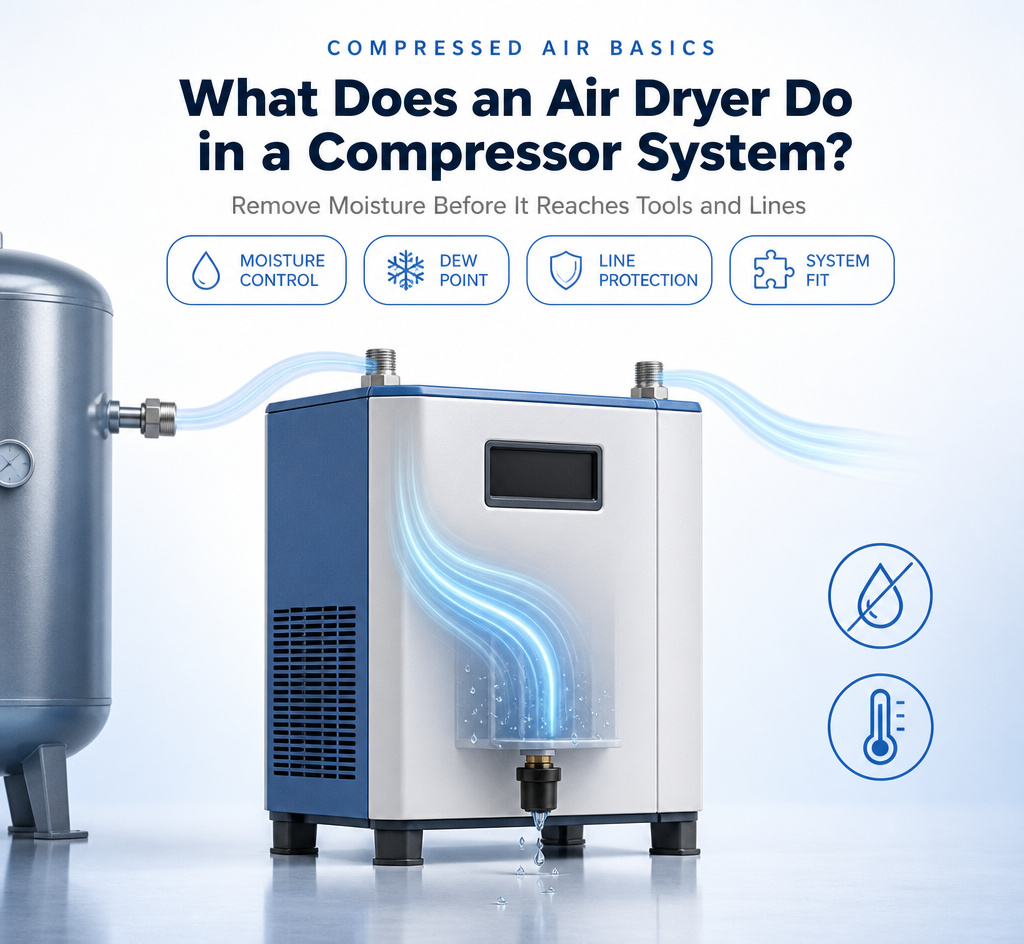
An air dryer is an essential after-treatment component installed in air compressor systems. Many industrial operators assume compressed air is clean and dry directly from the compressor, but atmospheric air always contains moisture. During compression, water vapor concentrates inside the air circuit, forming liquid water that harms equipment and production processes. An air dryer solves this problem by removing water vapor and condensed liquid from compressed air, ensuring stable, dry, and high-quality air delivery for all pneumatic applications.
While air compressors generate pressure airflow, air dryers purify and stabilize air quality. Together with filters, they form a complete compressed air purification system required for standard industrial workshops, manufacturing lines, and precision processing environments.
Core Purpose of an Air Dryer in Compressed Air Systems
The primary function of an air dryer is moisture removal. After air is compressed, high pressure forces water vapor to condense into liquid droplets. Without drying treatment, these water droplets flow through pipelines, valves, cylinders, and pneumatic tools continuously.
Air dryers lower the dew point of compressed air, trapping and discharging moisture before it enters downstream equipment. This process stabilizes air quality, eliminates water-related failures, and extends the service life of the entire compressed air system. Unlike filters that remove solid particles and oil mist, air dryers focus specifically on vapor and liquid water removal, filling the gap in compressed air purification.
Problems Caused by Moist Compressed Air
Equipment Corrosion and Wear
Persistent moisture inside air pipelines causes rust and corrosion on metal pipes, valve components, and tool interiors. Corroded particles break off and circulate in the air system, blocking small airflow passages and wearing internal seals. Over time, pneumatic cylinders stick, valves leak, and tools suffer frequent jamming and failure.
Moisture also accelerates aging of rubber seals and plastic components, leading to air leakage and increased maintenance frequency.
Finished Product Contamination
Wet compressed air severely affects production quality in sensitive industries. In spray painting operations, water droplets create bubble marks, uneven surfaces, and peeling paint layers. In food processing, pharmaceutical packaging, and electronic assembly, humid air causes surface defects, oxidation, and product contamination, leading to defective batches and economic losses.
For precision machining and laboratory applications, dry compressed air is a mandatory standard to guarantee product qualification rates.
Reduced Pneumatic System Efficiency
Excess moisture creates unstable airflow pressure and inconsistent tool operation. Wet air reduces tool rotation speed, lowers impact force, and slows down automated cylinder movement. Production efficiency drops significantly due to unstable air quality, even if the compressor pressure remains normal.
In addition, accumulated water dilutes residual compressor oil, worsening lubrication conditions and indirectly increasing compressor operating temperature and energy consumption.
Common Types of Air Dryers and How They Work
Refrigerated Air Dryers
Refrigerated air dryers are the most widely used type for general industrial applications. They work by cooling compressed air rapidly, forcing water vapor to condense into liquid water, which is then drained automatically. After cooling and dehumidification, the air reheats to normal temperature for stable delivery.
This dryer type offers stable performance, low maintenance cost, and large airflow processing capacity, suitable for conventional workshops, mechanical processing, and general pneumatic equipment.
Desiccant Air Dryers
Desiccant dryers use adsorbent materials to capture water vapor in compressed air, achieving extremely low dew point standards. They provide ultra-dry compressed air and are widely used in precision manufacturing, instrumentation, electronics, and low-temperature working environments.
Desiccant dryers are ideal for industries requiring strict air purity, where refrigerated dryers cannot meet drying requirements. Regular replacement or regeneration of desiccant materials ensures continuous drying performance.
Membrane Air Dryers
Membrane air dryers adopt hollow fiber membrane technology to separate water vapor from compressed air. Featuring no moving parts, no power consumption, and compact structure, they are suitable for small airflow, high-precision, and portable equipment scenarios.
They are commonly used in laboratory instruments, testing equipment, and small-scale precision pneumatic systems that require continuous stable dry air supply.
How to Match an Air Dryer to Your Compressor System
Air dryer selection must match the compressor’s airflow volume, working pressure, and application requirements. For conventional screw compressors used in mechanical processing and auto repair, refrigerated dryers are the most cost-effective option. For precision production lines, pharmaceutical and electronic industries, desiccant dryers are necessary to achieve ultra-low dew point air quality.
The dryer’s processing airflow must be greater than the compressor’s rated output to avoid overload operation. Working pressure range and ambient temperature adaptability should also be considered to ensure long-term stable operation.
Air Dryer Maintenance Best Practices
Regular maintenance ensures continuous drying efficiency. Keep the automatic drain valve clean to prevent water accumulation and blockage. Check temperature and pressure indicators daily to confirm normal operating status. For desiccant dryers, replace failed adsorbent materials regularly to avoid drying performance degradation.
Cooperate with complete filter replacement cycles. Clean and replace pipeline filters regularly to reduce oil and particle contamination, protecting the internal structure of the air dryer and extending equipment service life.
Conclusion
An air dryer functions as the core dehumidification device in a compressor system, removing water vapor and condensed moisture from compressed air to protect pneumatic tools, stabilize working efficiency, and guarantee finished product quality. Different types of air dryers adapt to different industrial scenarios, from general mechanical processing to high-precision manufacturing environments.
No industrial compressed air system is complete without qualified drying equipment. By installing and maintaining a suitable air dryer, users can avoid moisture-related failures, reduce maintenance costs, and achieve stable, efficient, and high-standard compressed air operation long-term.
Compressed Air Leaks: How Much Are They Costing You?
How to Choose the Right Air Compressor Size
Related Article