what type of oil does an air compressor take
What Type of Oil Does an Air Compressor Take? Base Fluid, Viscosity and the Separator That Has to Live With It
Ask what type of oil does an air compressor take and you will usually get a viscosity number back, as if one figure settled it. In an oil injected screw machine the oil is doing four jobs at once, it leaves the airend mixed into the air as a fine mist, and almost all of it has to be recovered and returned. That makes the choice a system decision rather than a shelf decision.
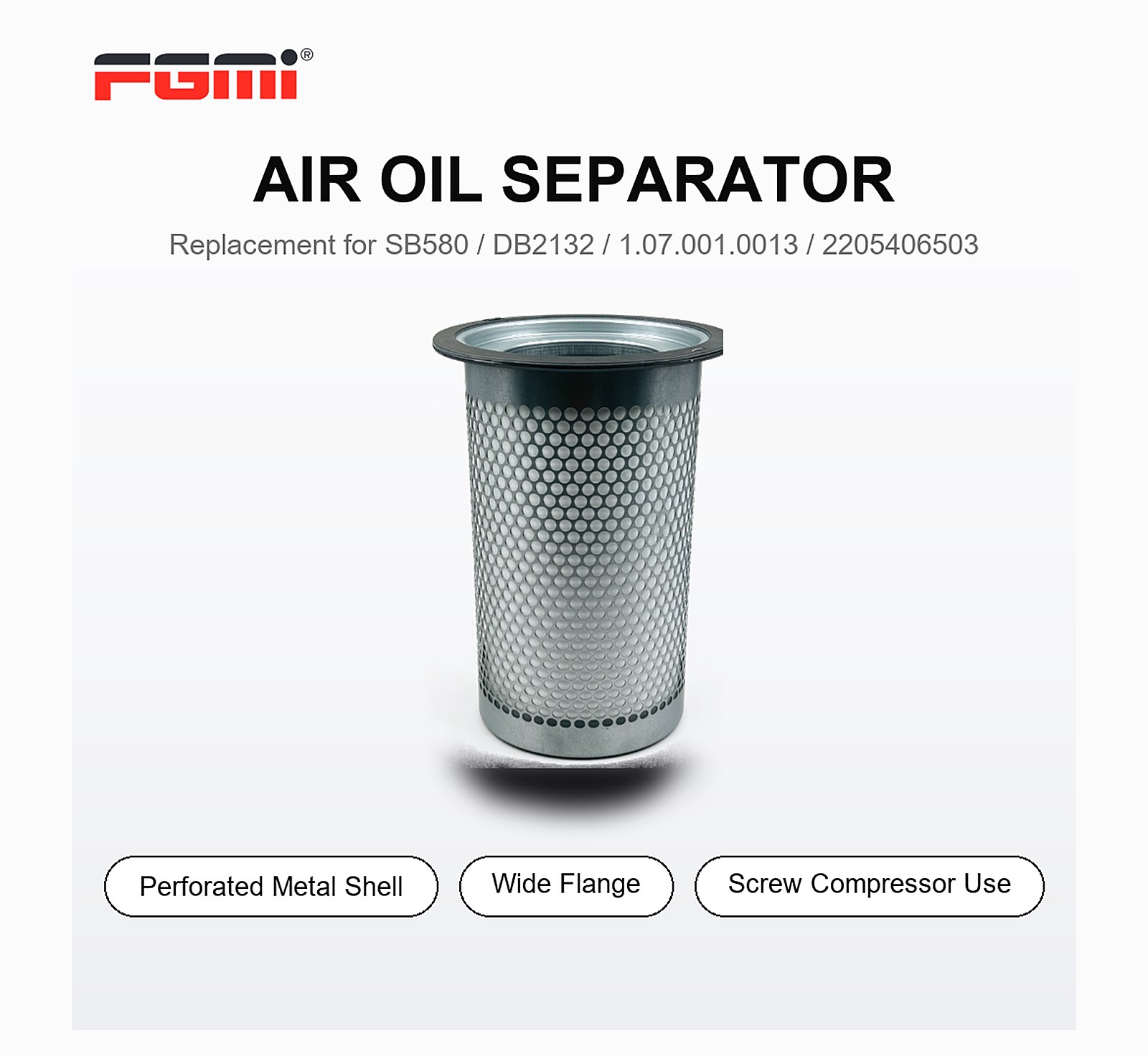
This page separates the three things the word type hides, explains why the answer travels through the air oil separator rather than stopping at the fill port, and then gives the specification sheet for a real element, the FGMI Air Compressor Oil Separator SB580 DB2132 1.07.001.0013 OD200xH305mm Filter Element for Screw Air Compressor Spare Parts, with the source of every line so a buyer can see what is declared and what is not.
What the Word Type Actually Covers
Three specifications sit under the word type, and a lubricant can satisfy one and fail on the other two.
- Base fluid. This is the carrier: a mineral oil, a semi synthetic blend, or a full synthetic such as a PAO. The base fluid governs how the oil behaves at temperature, how long it resists oxidation inside a hot air end, and how it treats the seals and gaskets it sits against.
- Viscosity grade. Rotary screw compressors are specified on an ISO viscosity grade, written as a VG number measured at 40 degrees Celsius. Two oils that share a grade are not interchangeable, because the grade says nothing about the additive package or the base fluid behind it.
- Additive package and duty class. Anti oxidation, anti wear, demulsibility and foam control are formulated for a duty. A compressor oil is expected to run continuously at elevated temperature in contact with compressed air; a differently formulated oil of the same viscosity is a different product.
The practical rule for air compressor oil is to read the machine data sheet as a whole sentence. Grade alone is the number a supplier can quote from memory, which is exactly why it is the least reliable place to start.
Why the Oil Question Is Also a Separator Question
In an oil injected screw compressor the oil is injected into the airend to seal the clearances, carry away the heat of compression and lubricate the rotors. It then leaves with the discharged air as a mist of very fine droplets, and the air oil separator is the component that recovers it. A replacement element therefore sees the oil exactly as the fill port dictated it, for its whole service life.
- The mist arrives at the media from the outside. Air loaded with oil droplets enters the element through the perforated metal shell, and the pleated pack catches the droplets while letting the air pass.
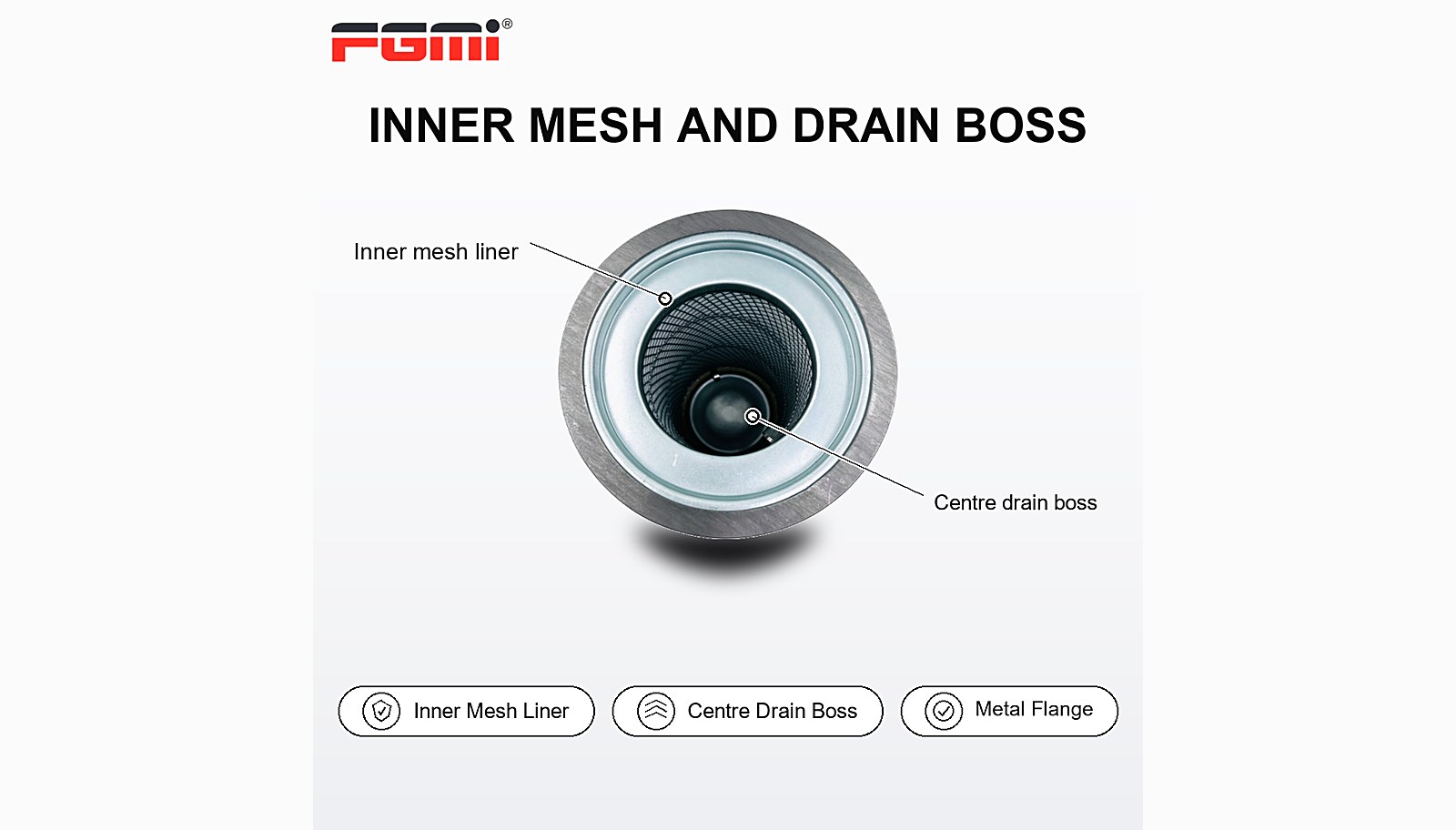
- Caught oil collects and drains back. Look into the end of the element and you can see the inner mesh liner and the raised boss in the centre of the flange. That centre drain is the route the recovered oil takes back to the sump. If it cannot drain, the oil goes forward into the line instead.
- What drains and what passes is the whole specification. The residual oil content of the delivered air, the pressure drop across the element and how long the pack lasts are all properties of the separator, and on the listing used as the worked example here none of the three are published.
So when a plant asks what type of oil does an air compressor take, the economically important part of the question is what that oil will do to the separator over three or four thousand hours. A fluid the machine accepts but the pack does not, or the other way round, shows up as oil in the air line and a separator replaced early.
What Goes Wrong When the Oil Is Wrong
A wrong oil rarely stops a machine. It changes the operating envelope slowly, and the first parts to show it are the ones downstream of the airend.
- Oil carry over into the air line. If the pack cannot coalesce the oil as it is delivered, droplets pass into the receiver and the dryer. The earliest visible sign is a film in the condensate trap that was not there at the last service.
- Pressure drop that never comes back down. Oxidised or contaminated oil thickens and varnishes. The separator takes the load, its differential climbs, and the machine burns more power for less delivered air.
- Seal and gasket trouble. Base fluids are not equally friendly to every elastomer. A substitute that the airend tolerates can still attack a seal somewhere else in the package.
- A separator that dies young. The element is the cheapest component in the oil circuit and the first to absorb the consequences, which is why a cheap substitution on oil so often gets blamed on the filter.
The Separator Specification Sheet, With Its Source
These are the lines worth having in writing before a separator is ordered, and the right hand column states where every value on this page came from. Anything reading Not published is genuinely absent from the listing used as the worked example, and has deliberately not been filled with a typical figure.
| Specification line | Value | Source of this line |
|---|---|---|
| Product name | Air Oil Separator | Listing attributes |
| Model | SB580 | Listing attributes |
| Cross reference numbers | SB580, DB2132 and 1.07.001.0013 from the listing title, with 2205406503 printed on the product photograph | Listing title, plus product photograph |
| Type | air oil separator | Listing attributes |
| Materials | Filter Paper and Metal | Listing attributes, two separate material lines |
| Outer diameter | 200 mm | Listing attributes, stated as OD 200 mm x H 305 mm |
| Overall height | 305 mm | Listing attributes, same line |
| Weight | 3.99 kg | Listing attributes |
| Packed size and weight | 24 x 24 x 36 cm, 3.99 kg | Listing shipping block |
| Visible construction | Perforated metal shell, wide metal flange, inner mesh liner and a centre drain boss | Product photographs |
| Residual oil content of delivered air | Not published | Not declared on the listing |
| Pressure drop across the element | Not published | Not declared on the listing |
| Dirt holding and separator service life | Recommended 3,000 to 4,000 hours under normal conditions, with the listing stating actual life depends heavily on the operating environment | Listing FAQ |
| Approved compressor oil grade or base fluid | Not published | Not declared on the listing, and not something a separator listing should be used to decide |
| Compatibility with synthetic oils | Not published | Not declared on the listing |
| Maximum operating temperature and pressure | Not published | Not declared on the listing |
| Colour | Brown | Listing attributes |
| Certificate named in attributes | ISO9001, with three certificate records attached to the listing whose titles were not returned in the data pulled | Listing attributes and certificate block |
| Test documentation | Video outgoing inspection provided, machinery test report provided | Listing attributes |
| Minimum order | 1 unit | Listing trade block |
| Lead time | 15 days for a quantity of 9 in the shipping block; the FAQ states in stock items ship within 1 to 3 days | Listing shipping block and FAQ |
| Customisation | Logo customisation available from a minimum of 1 piece | Listing FAQ |
| After-sales | Online support | Listing attributes |
| Country of origin | China | Listing attributes |
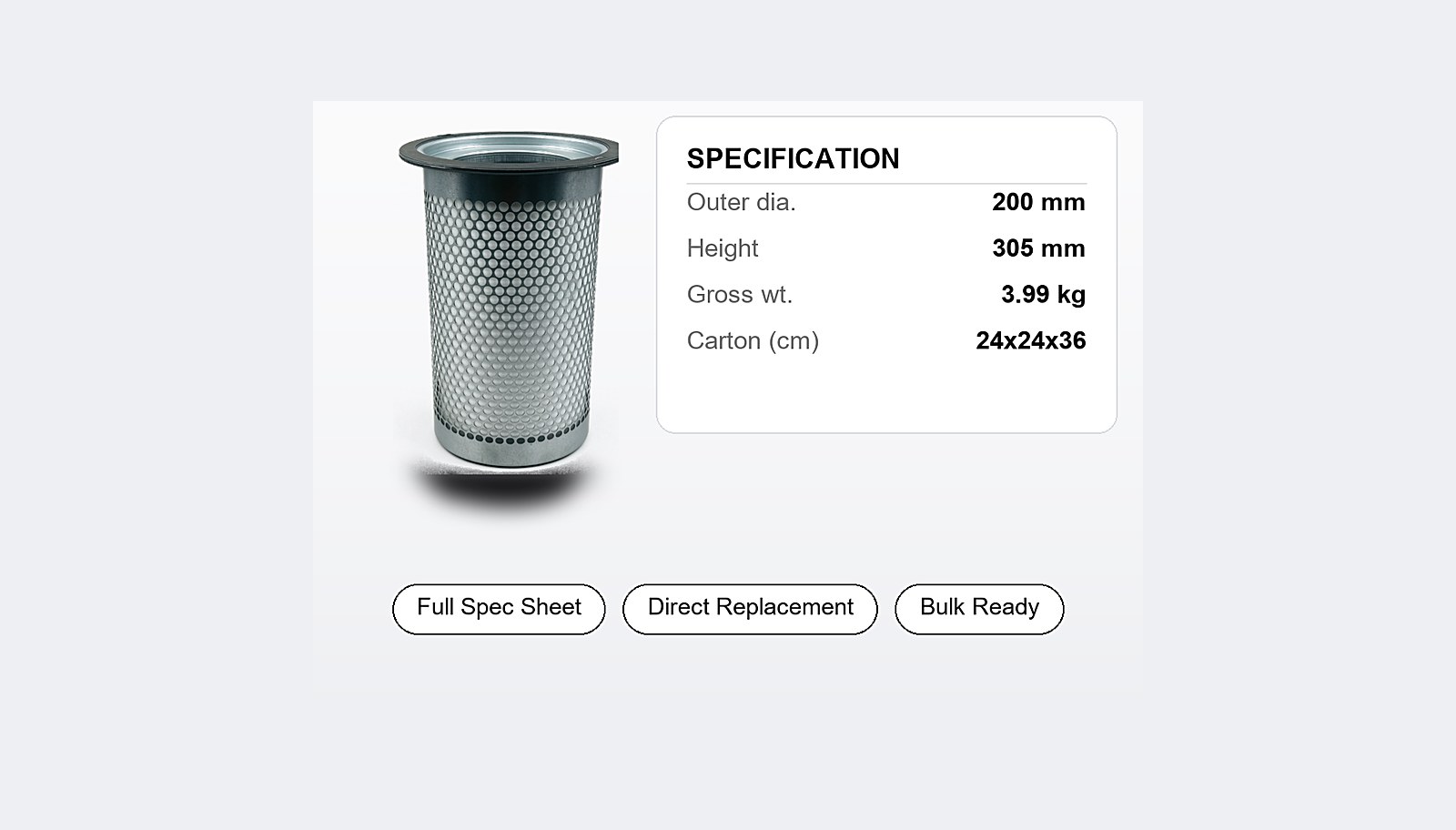
The conclusion is narrow: the SB580 can be confirmed as a physical replacement from three numbers on this page, 200 mm outer diameter, 305 mm height and the flange form, while the three lines that decide whether it performs, residual oil content, pressure drop and fluid compatibility, have to be obtained from the supplier rather than read off the listing.
How to Specify Oil and Separator Together
Ordering both parts of the question in one pass avoids the argument later. Five lines on the requisition are enough.
- Copy the machine data sheet, do not paraphrase it. Take the base fluid, the ISO viscosity grade and the manufacturer oil designation straight from the compressor documentation, and put that wording on the enquiry.
- Ask the separator supplier what the element was tested with. A supplier who can name a test fluid and a test method is a supplier who has measured residual oil content rather than estimated it.
- Require residual oil content and pressure drop as numbers. Residual oil in the delivered air and the clean differential are the two figures that separate a real separator from a perforated tube with paper in it.
- State the condensate behaviour you need. If downstream equipment cannot tolerate oil aerosol, say so, because it changes both the oil choice and the treatment train, not just the element.
- Change oil and separator as one event. New oil in a saturated element picks up the contamination it was meant to replace, and the service interval then fails on both parts at once.
Frequently Asked Questions
Summary and How to Order With Confidence
Answer what type of oil does an air compressor take from the machine documentation, not from the shelf, and then buy the separator against measured numbers rather than a part number. Those two steps remove most of the cost from a failure that is otherwise blamed on the filter.
Before an order, get four answers in writing against a named element: residual oil content of the delivered air, clean pressure drop, the fluid the element was tested with, and the service interval assumed. Everything else on this page can be checked in the yard with a tape measure.
Send the compressor make, model, serial and the oil actually in the machine, together with the outer diameter, height and flange form of the element being replaced. We will confirm fit, then answer residual oil content, clean differential and test fluid against a named model before anything is quoted.
what is compressed air
which way does air filter go
Related Article