what size air compressor do i need
What Size Air Compressor Do I Need? Sizing by Air Volume, Pressure and Storage
Ask three suppliers for a machine and you will get three different answers to the same question, because air compressor sizing is not one number. A 15 kW rating tells you what the motor draws. It does not tell you how much air the machine delivers, how long it can hold that pressure while a valve snaps open, or whether the plant down the corridor will see the gauge drop. Buyers size on power because power is the figure printed on the nameplate, then discover that the tool list was the real specification.
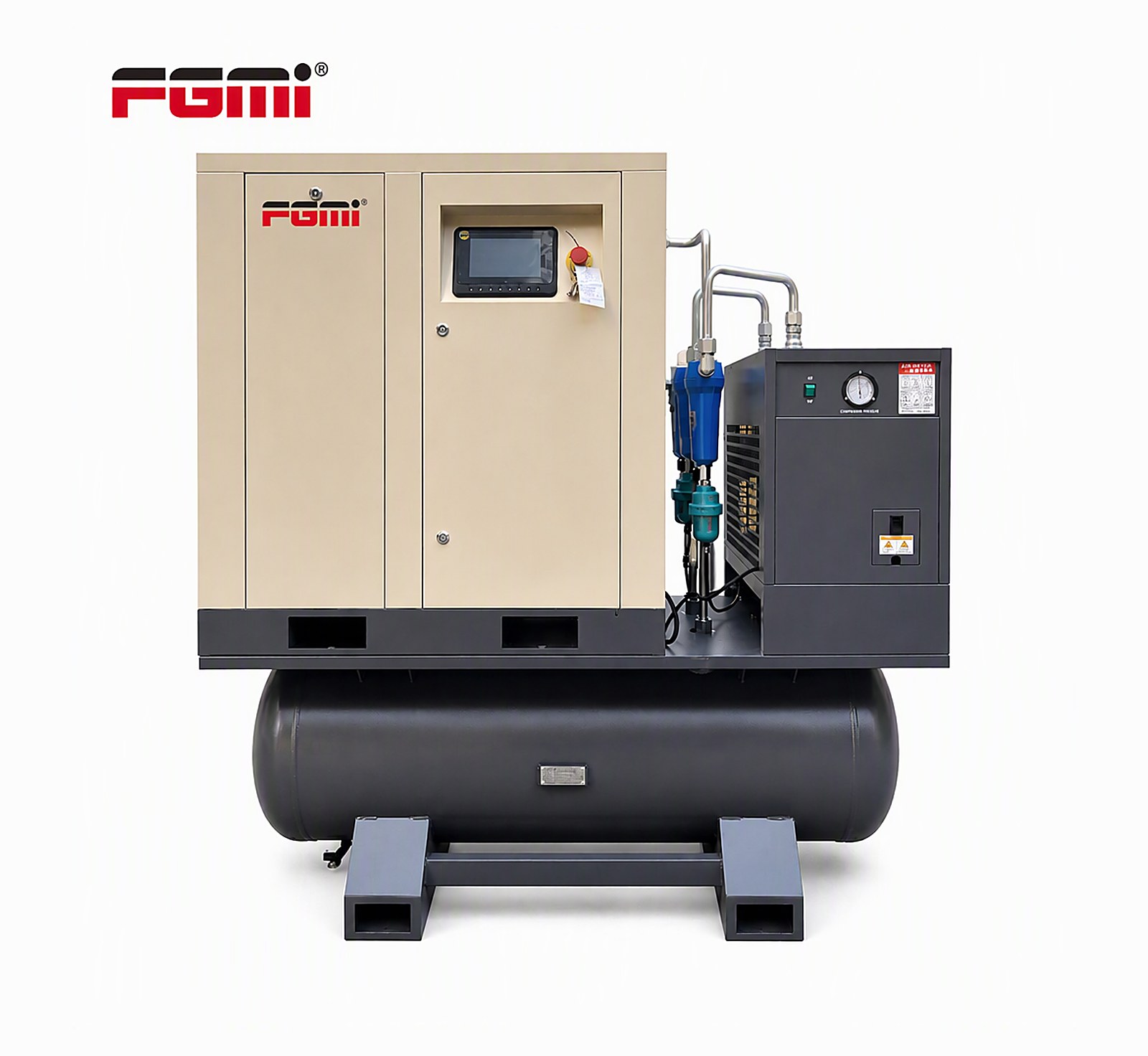
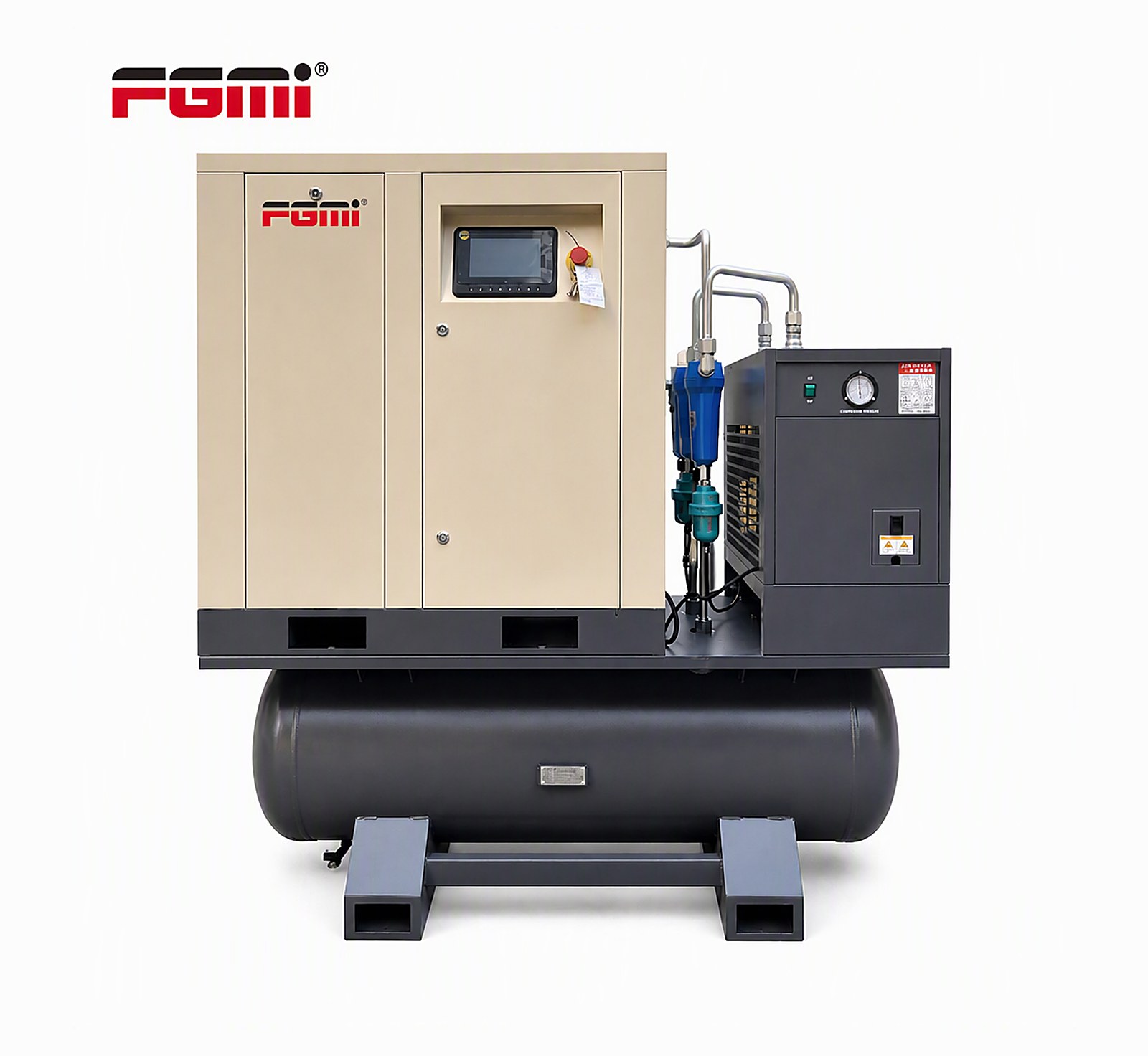
This page sets out the three axes that actually decide the answer to what size air compressor do I need, the load profile you have to identify first, a six step method from tool list to machine, and a specification sheet that states where every number came from. Worked against a real package: the All in One Screw Air Compressor 15kW with Dryer and 400L 500L Air Tank Rotary Integrated Package FGMI.
- What Size Actually Means: Three Independent Axes
- Four Load Profiles That Decide the Machine
- The Specification Sheet to Demand, With the Source of Every Line
- Six Steps From Tool List to Machine Selection
- Where an Integrated Package Beats a Piece-by-Piece Build
- Frequently Asked Questions
- Summary and How to Get a Sized Quote
What Size Actually Means: Three Independent Axes
The word size carries three separate specifications, and a machine can be right on two of them and wrong on the third.
- Delivered air volume, quoted as free air delivery, is how much atmospheric air the machine swallows and compresses per minute. Every tool downstream consumes air measured this way, so this is the axis the selection is built on. Motor power is only the input that produces it, and two airends driven by the same 15 kW motor can deliver noticeably different volumes.
- Working pressure is the pressure the system is held at, and it decides whether a tool runs at all. Flow sized at 7 bar does not satisfy equipment fed at 10 bar, and a machine that reaches 13 bar while the plant needs 7 loses money on every running hour.
- Storage volume in the receiver is the buffer that covers short peaks above the delivered flow and lets the machine unload instead of stop-starting. It is measured in litres and chosen from the demand pattern, not from the size of the workshop.
Add a fourth consideration that is easy to postpone and expensive to retrofit: air quality. Compression pulls in humid ambient air, and the water, oil aerosol and particulate that leave the airend decide whether a paint finish, a laser optic or a pneumatic valve survives. The package used here carries the treatment stages on the same chassis as the compressor, which is why the treatment row of the specification sheet is answered rather than deferred.
Four Load Profiles That Decide the Machine
Identify how the demand behaves over a shift before comparing any specification. Two workshops with the same total tool count can need opposite machines.
| Load profile | How the demand behaves | What decides the machine | The failure mode |
|---|---|---|---|
| Intermittent hand tools Blow guns, nailers, occasional impact wrenches |
Long quiet stretches broken by one or two second bursts | Storage volume and control type. Delivered flow only has to cover the average, because the receiver pays for the peaks | Sizing on the loudest single moment and buying a machine that then runs unloaded most of the day |
| Continuous process air Laser assist gas, air bearings, textile spinning, aeration, conveying |
Demand never stops while the line runs | Delivered volume has to exceed the continuous sum with margin. Storage is almost irrelevant | Sizing on a catalogue figure and finding the pressure sags once the line reaches operating speed |
| Machine tool support CNC tool changers, work clamping, blow-off, probe air |
Modest volume, very frequent solenoid events, long idle periods while the valves hold pressure | Stability of the pressure band and the leak quota, not peak flow | Ignoring the drop between a loaded and an unloaded gauge reading, then blaming the compressor for a manifold leak |
| Abrasive blasting Blast cabinet, open blast room, shot cleaning |
The largest consumption per operator, sustained for hours, steeply sensitive to nozzle bore | Delivered volume per nozzle multiplied by the nozzles running together | Sizing for one nozzle when the shop plans two, because volume per nozzle rises steeply as the bore opens |
The practical consequence is that a sized quotation has to state the profile, not only the equipment list. The 15 kW machine used as the worked example here can be the correct answer for a blasting room running a single nozzle and the wrong answer for a plating line that draws a smaller volume continuously for sixteen hours.
The Specification Sheet to Demand, With the Source of Every Line
Request the numbers below in writing before a price is discussed. The right-hand column states where each value on this page came from, so a buyer can separate what is declared from what is assumed. Rows reading Not published are genuinely absent from the FGMI listing used as the worked example, and have deliberately not been filled with an industry typical value.
| Specification | Value | Source of this line |
|---|---|---|
| Product | All in One Screw Air Compressor 15kW with Dryer and 400L 500L Air Tank Rotary Integrated Package FGMI | Listing title, copied verbatim |
| Rated motor power | 15 kW | Listing attributes |
| Free air delivery | Not published | Not declared on the listing |
| Working pressure | Not published | Not declared on the listing |
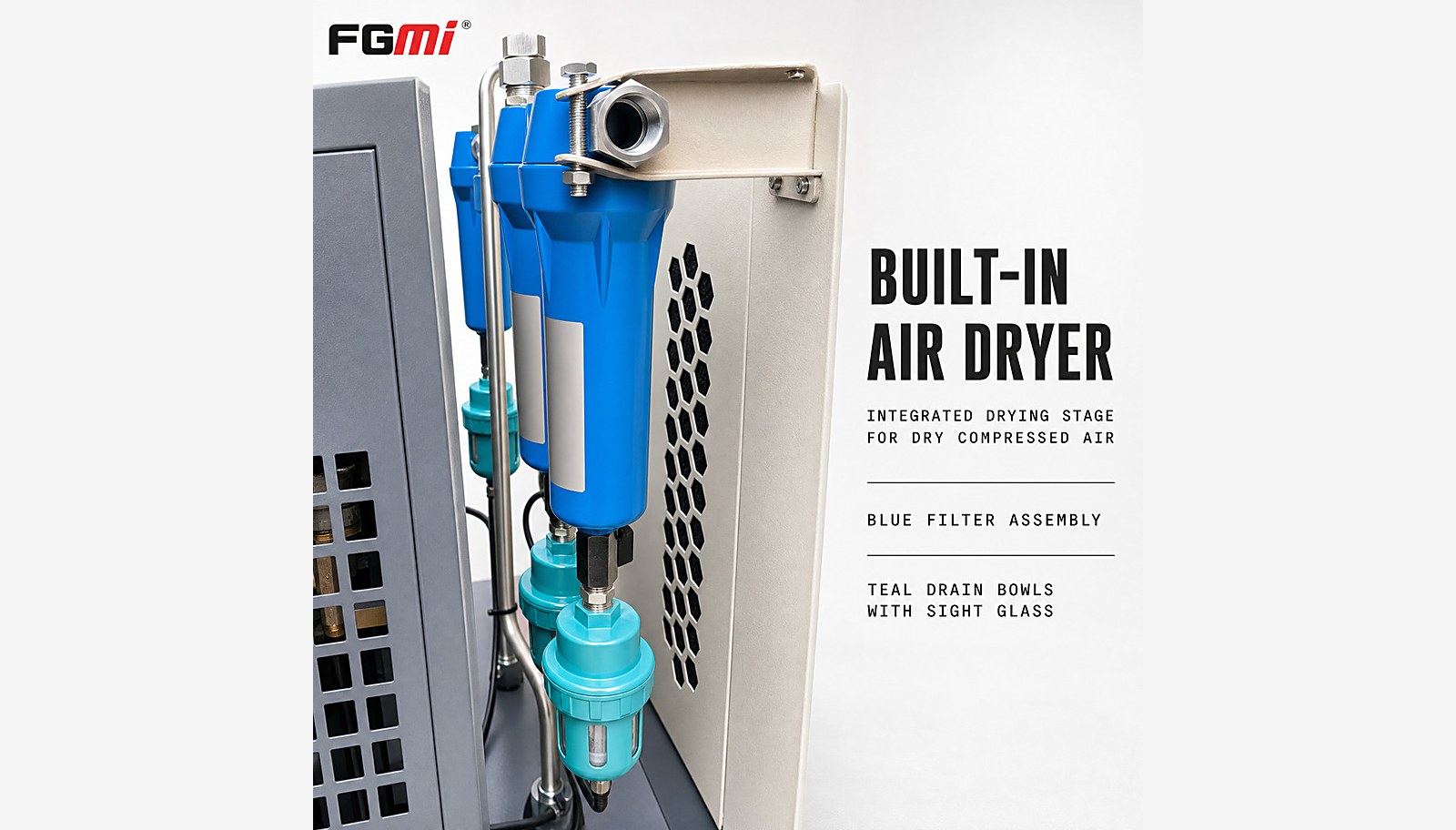
| Air dryer | Included, mounted on the same chassis | Listing title, plus product photographs |
| Air receiver | 400L or 500L, integrated in the chassis | Listing title |
| Line filtration | Three in-line filter housings with drain bowls, two carrying a sight glass | Product photographs |
| Filter grade and pressure dew point | Not published | Not declared on the listing |
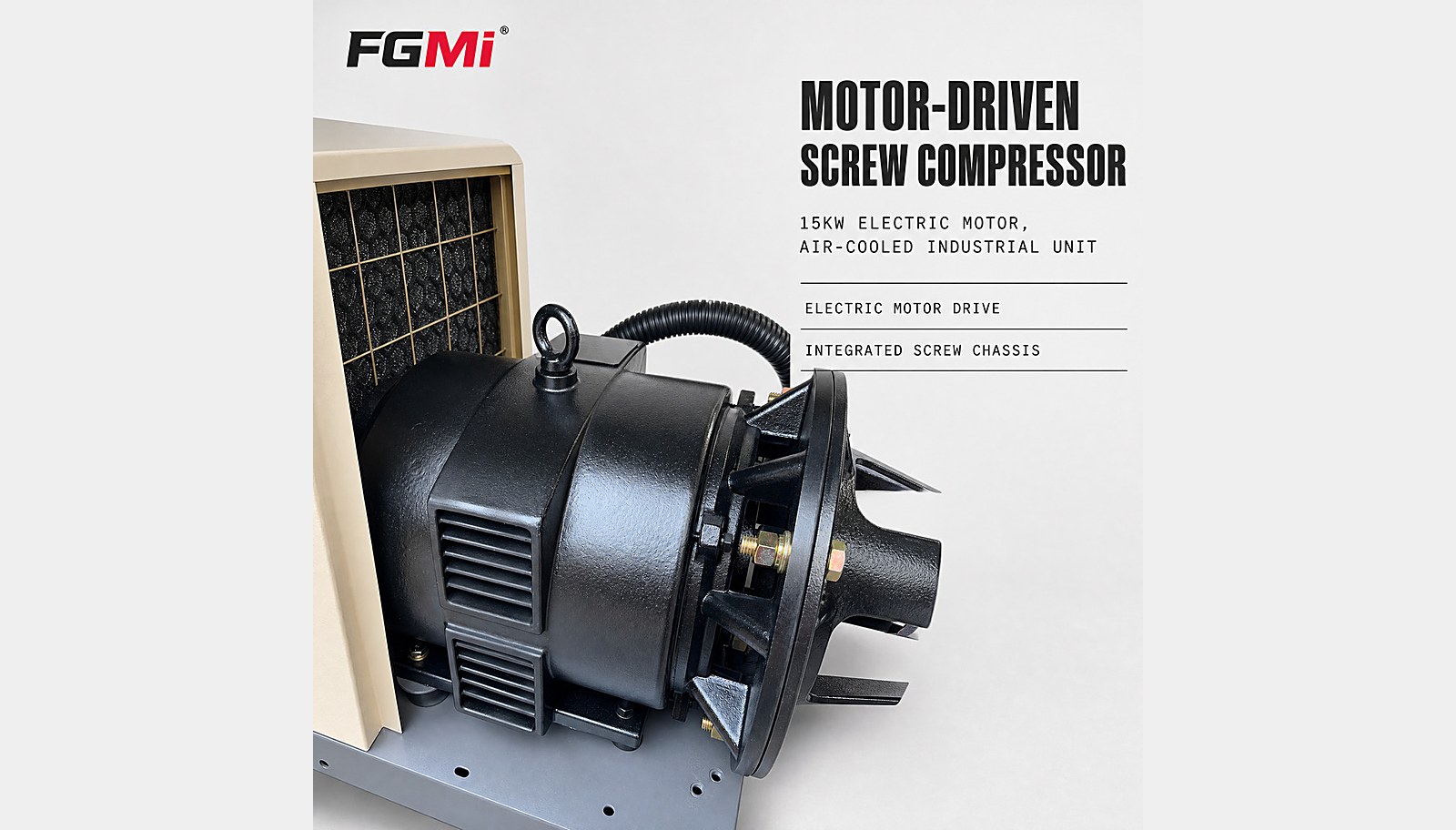
| Drive | Electric motor mounted to the airend on a common chassis | Product photographs of the motor and airend assembly |
| Cooling method | Air cooled | Listing keywords name an air cooled industrial compressor |
| Core components | Motor, Bearing, Gear, Pump, Engine, PLC | Listing attributes |
| Control interface | Touch screen panel on the enclosure, with emergency stop | Product photographs, PLC listed as a core component |
| Colour options | Blue, White | Listing attributes |
| Machine weight | 300 kg | Listing attributes |
| Packed dimensions | 130 x 130 x 150 cm | Listing shipping block |
| Packed weight | 300 kg | Listing shipping block |
| Minimum order | 1 unit | Listing trade block |
| Lead time | 15 days for a quantity of 1 | Listing shipping block |
| Customisation | Packaging and Logo or Pattern, available from 1 unit | Listing customisation block |
| Warranty | 1 Year on the listing, carried here as 1 year from shipment | Listing attributes, plus this site standard |
| Certificates | Two certificate records are attached to the listing; their names and scopes were not returned in the data pulled for this article | Listing certificate block |
| Country of origin | China | Listing attributes |
| Sound pressure level | Not published | Not declared on the listing |
| Supply voltage | Not published | Not declared on the listing |
The conclusion a buyer should draw is narrow and useful: delivered volume, working pressure, dew point and sound level are the four lines that decide whether a machine fits the job, and on this listing none of the four are published. Send the tool list and the required pressure, and have those four answered in writing against a named model before the order is placed.
Six Steps From Tool List to Machine Selection
The sequence matters more than the arithmetic. Each step removes one way of buying the wrong machine, and every step is answered with a number the buyer already has or can measure in ten minutes.
- Write the tool list as volumes, not as counts. Every pneumatic tool has a consumption in litres per second or cubic metres per minute at a stated pressure. A count of twelve tools tells you nothing; twelve figures that can be added tells you everything. Where a catalogue quotes consumption at a pressure different from your plant pressure, correct it before adding, because consumption rises with the absolute pressure ratio.
- Apply a simultaneous-use factor. Add only the tools that can realistically run together. A fabrication shop with one welder and three blasters does not need the sum of all four if the process never opens all four valves, and it does need the full sum on the day the schedule slips. When in doubt, size for the shift pattern you actually run, not for the busiest hour in history.
- Turn the running sum into required delivered volume. The delivered volume of the machine has to cover the average demand of the profile identified in section two, plus a margin for future taps and for leakage in the manifold. Leakage is not a rounding error: a plant that has never been surveyed for leaks is normally losing a meaningful share of everything the machine makes, and a compressor sized to the exact tool total will simply run longer to stand still.
- Set the pressure band, then add the losses. Take the highest equipment requirement in the plant, then add the drop across the dryer, the filters, the manifold and the longest hose run, then set the machine to switch a bar or so above that. This is the step that explains a gauge reading correctly at the machine while the tool at the end of the line is short.
- Size the receiver from the gap, not from the room. The storage volume exists to absorb the difference between peak demand and delivered flow, and to stop the machine cycling on short events. A plant dominated by one second bursts needs litres; a plant with steady continuous demand needs almost none. This is why the worked example is offered in two tank sizes, 400L or 500L, on the same compressor rather than as a single fixed figure.
- Match the treatment to what the air does. Air that only drives a cylinder needs different handling from air that touches a product. Set the filtration grade and the dew point before the machine is chosen, because the dryer and the filters take floor space and a condensate route, and adding them later is where compressed air installations become untidy.
Where an Integrated Package Beats a Piece-by-Piece Build
A conventional installation assembles the compressor, the refrigerated dryer, the receiver and the filters as four separate purchases, then connects them with pipework the buyer also has to specify. An integrated package puts the same stages on one chassis. The difference is not cosmetic, and it shows up in three places a buyer pays for.
- Footprint and services. One machine location, one set of fork slots, one condensate point, instead of a row of equipment and the floor space between it. For a retrofit into a building that was never designed with a plant room, this is often the deciding constraint.
- Interconnecting losses. Pressure drop between the stages is the usual cause of the dry air arriving at a lower pressure than the compressor produced. Short factory pipework removes most of that before the buyer has to specify it.
- Commissioning time and accountability. The stages arrive wired and plumbed, and one supplier answers for the whole skid. Where the dryer is bought separately, a wet line is normally argued about between two vendors before it is fixed.
The package used as the worked example carries the drying and filtration stages on the compressor chassis: the listing title states a dryer and a 400L or 500L tank in the integrated assembly, and the photographs show three in-line filter housings with drain bowls mounted alongside the dryer. What the listing does not state is the filtration grade, the achieved pressure dew point and the delivered volume, so an integrated package still has to be checked against the four critical lines from section three before it is ordered.
Frequently Asked Questions
Summary and How to Get a Sized Quote
The answer to what size air compressor do I need is a delivered volume at a stated pressure, chosen from the way the plant actually consumes air, with the receiver picked afterwards to cover the gap. Power ratings, tank litres and cylinder bores are all secondary to those two figures, and a quotation that offers only a power rating has not answered the question.
Send the tool list with its consumption figures, the highest single equipment pressure, the run pattern over a shift and the required air grade. Those four inputs produce a machine selection. Anything narrower than that is a price, not a solution.
Give us the tool list with consumption figures, the working pressure you must hold, the number of hours the air runs and the air grade the process needs. We will confirm delivered volume, pressure band, dryer dew point and filtration grade against a named model before anything is quoted, and the packaged or piece-by-piece choice follows from those answers.
which way does air filter go
how to change air filter
Related Article