how much is an air compressor

Air Compressor for Printing: Specifying a 7.5 kW Rotary Screw Machine That Survives a Print Shop
Print shops do not fail on compressed air in obvious ways. They fail in the print: a halo of oil bleed around a halftone dot, solvent-based washdown mist pushed back onto a plate, sheets sticking in the feeder because the air feeding the suction heads is damp, a varnish roller scored by particulate blown out of a 10-year-old pipe loop. Each of those costs a run, not a machine, which is why the buyer who gets this right is not the one comparing horsepower figures — it is the one who specifies dryness, oil content and stable pressure alongside flow.
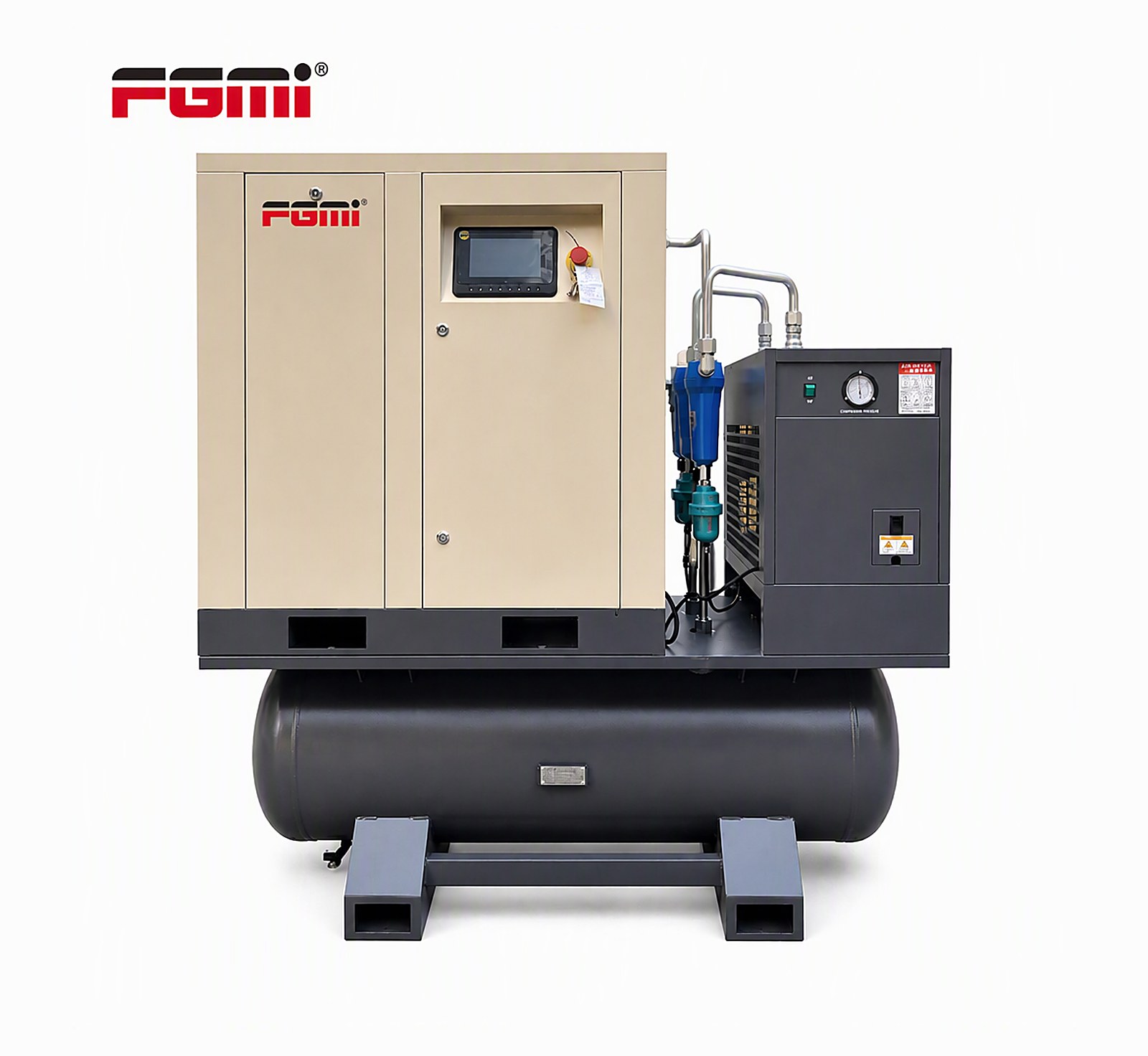
This guide walks through the specification of a 7.5 kW rotary screw air compressor for printing duty — declared flow 0.28 to 1.3 m³/min, 380 V or 220 V, air-cooled, 180 kg — and gives the arithmetic a purchasing engineer needs to size flow, prove the 100 PSI working claim, keep oil aerosol off the sheet, and get a 180 kg machine through the door it has to enter.
- What "Air Compressor for Printing" Means as a Specification
- Types of Compressor at Print-Shop Duty, and Where a Screw Unit Wins
- Full Specification Table, With Data Source Stated Per Row
- Printing Applications and the Air Quality Each One Demands
- Six-Step Selection Method for a Print Shop
- Frequently Asked Questions
- Summary, Ownership Cost, and How to Order a Built-to-Order Set
1. What "Air Compressor for Printing" Means as a Specification
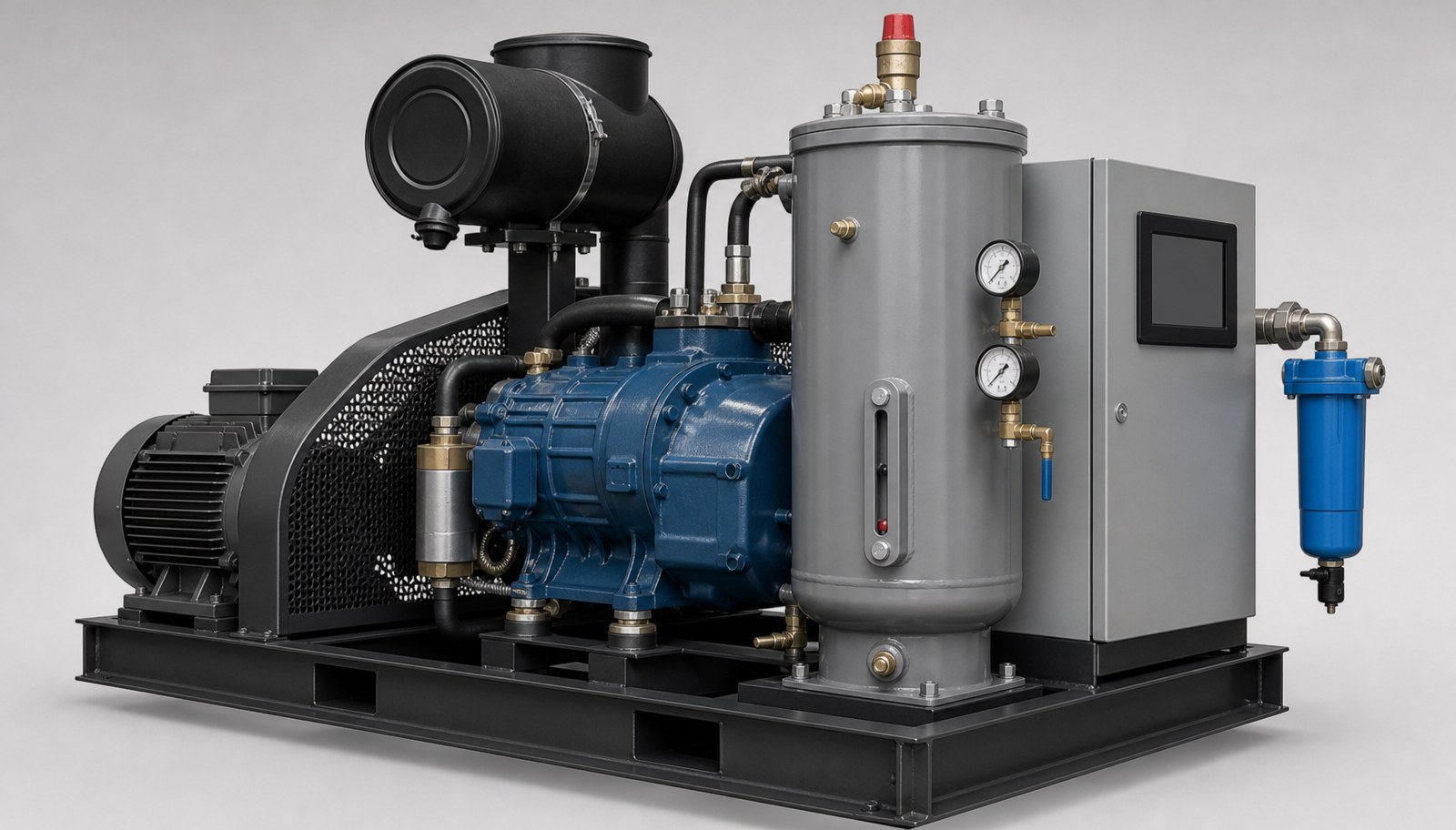
A rotary screw air compressor draws ambient air through an intake filter and compresses it continuously between two meshing helical rotors, rather than in pulses as a piston machine does. In a print shop that distinction matters for one reason: the air supply to a press is a continuous load, not a burst. Feeder heads, air knives, web cleaners and delivery blow-off all draw while the machine runs, so a screw element sized to the duty holds header pressure where a piston unit would cycle itself to death.
"For printing" is not a machine category — it is an air-quality duty. It tells you three things to specify on the purchase order:
- stable flow, not peak flow. Print air is on for hours. Size to the continuous demand of everything that can fire at once, then add leakage.
- oil removal at the point of use. A lubricated (oil-injected) screw airend — as this one is — leaves oil aerosol in the discharge. Unfiltered, that is the direct cause of oil bleed, set-off and ghosting on a print.
- dew-point control. A press room swings in temperature. Air that is dry at the compressor condenses where the pipe is cold, and that water ends up on the sheet or in the ink film.
Read the spec before the price. A compressor sold as "quiet" without a declared sound level in dB(A) at 1 m is a claim, not a specification. This machine is declared mute: No, meaning no acoustic enclosure is fitted, and no dB(A) figure is published — see the specification table and the siting advice in section 5.
2. Types of Compressor at Print-Shop Duty, and Where a Screw Unit Wins
| Type | Where it belongs in a print shop | What it costs you in practice |
|---|---|---|
| Oil-injected rotary screw (this machine) | Press-driven duty: feeders, air knives, web cleaning, delivery blow-off, ink agitation, folder-gluers and die-cutters running a full shift. | Best efficiency and lowest cost per kW. Needs coalescing filtration at the point of use and an oil-plus-filter service interval. |
| Oil-free screw | Where any hydrocarbon is unacceptable: food and pharmaceutical packaging printing, clean-room label work, some security printing. | Higher purchase price and shorter element life; still needs drying and particulate filtration, because oil-free is not dry-free. |
| Piston / reciprocating (belt or direct drive) | A screen-printing bench, a small pad-printing cell, a platen die-cutter used a few hours a day. | Lowest capital cost. Duty-cycle limited, more vibration, and a pulsating supply that a full-size press will drain. |
| Tank-mounted portable screw | Multi-bay shops, plant-hire, and sites where the press layout moves. This build is declared configuration: Portable. | One-man repositioning between jobs, but at 180 kg net it is a trolley move, not a carry. |
| VSD (variable-speed drive) screw | Shops with widely swinging demand between job changeovers. | Pays back only where the machine would otherwise idle unloaded for long periods. This build is a fixed-speed load-unload machine. |
3. Full Specification Table, With Data Source Stated Per Row
Values below are the manufacturer's declarations for this model. Where a figure needed for a print-shop decision has not been published, the row says so instead of quoting an industry typical — the two that matter most here are maximum working pressure and sound level.
| Parameter | Value | Data Source |
|---|---|---|
| Product | FGMI 7.5 kW Screw Air Compressor for Printing, industrial grade, 100 PSI duty | Product listing |
| Type | Screw (rotary) right choice for continuous press duty | Supplier declaration |
| Gas type | Air | Supplier declaration |
| Rated power | 7.5 kW (10 HP class) | Model designation |
| Power source | AC power | Supplier declaration |
| Voltage | 380 V, 220 V, Other — state yours on the order | Supplier declaration |
| Air capacity (free air delivery) | 0.28 to 1.3 m³/min (9.89 to 45.91 ft³/min) range covers the platform — demand the figure at YOUR pressure | Supplier declaration |
| Maximum working pressure | Not declared for this build. The listing quotes 100 PSI duty; 100 PSI = 6.9 bar, so confirm the machine's maximum discharge pressure and the regulated working pressure separately before you rely on it | Conversion is arithmetic; the rating is not published |
| Lubrication style | Lubricated (oil-injected) — requires point-of-use coalescing filtration for print duty | Supplier declaration |
| Cooling method | Air cooled — needs clearance at the cooler and intake air below roughly 40 °C | Supplier declaration + standard screw practice |
| Configuration | Portable | Supplier declaration |
| Core components | PLC, Pump, Gear | Supplier declaration |
| Sound enclosure (mute) | No. No acoustic enclosure is fitted and no dB(A) figure is published — treat siting and hearing-zone assessment as your cost, not the supplier's | Supplier declaration |
| Machine dimensions (L × W × H) | 890 × 650 × 830 mm | Supplier declaration |
| Net weight | 180 kg | Supplier declaration |
| Package size (single item) | 905 × 800 × 980 mm — the listing labels this "cm", which for a 7.5 kW machine is a unit error; 905 cm would be a 30-foot crate confirm on the packing list before booking freight | Supplier declaration, unit corrected from machine size + 15 mm clearance per side |
| Packed volume | 0.71 m³ — calculated from 0.905 × 0.800 × 0.980 m | Arithmetic from declared package size |
| Gross weight | 195 kg (packing allowance 15 kg) | Supplier declaration |
| Warranty | 1 year — consistent with the site-wide FGMI policy stated as 1 year from shipment | Supplier declaration |
| Inspection before shipment | Machinery test report provided; video outgoing inspection provided | Supplier declaration |
| Brand / origin | FGMI / Guangdong, China. Colour and configuration built to order | Supplier declaration |
| Packing unit | Single item | Supplier declaration |
| Dryer and filtration scope | Not declared. For print duty specify the refrigerated dryer's pressure dew point and a point-of-use coalescing filter as line items, not assumptions | Not declared |
How to read this table: "Supplier declaration" means the value is published for this model and should appear on the nameplate or packing documents. "Arithmetic" rows are calculated from declared values, shown so you can check them. "Not declared" rows are left open on purpose — a supplier who can answer them in one email is a supplier you can specify from; one who cannot should not reach your shortlist.
4. Printing Applications and the Air Quality Each One Demands
The same 7.5 kW machine is a good fit for some print processes and the wrong specification for others. What separates them is not pressure — it is what the air touches.
| Process | What the air does | Air quality that actually protects the print |
|---|---|---|
| Sheet-fed litho / offset press | Feeder suction heads, pre-swelling, air knife and buffer table, delivery blow-off and stack levelling. | Dry and oil-free at the nozzle. Oil aerosol onto freshly inked sheets shows as set-off and ghosting; moisture makes sheets curl and the feeder mis-pick. |
| Screen printing (manual and rotary) | Ink agitation, stencil washdown, part blow-off, table vacuum relief. | Particulate-free. Blow-off water and oil on a freshly cured print leave pinholes and halo rings around fine halftones. |
| Flexo and rotogravure | Web cleaning and threading, doctor-blade assist, nip loading, edge trim extraction. | Stable, pulsation-free supply with tight pressure regulation. Pressure ripple prints as a repeating density band across the web. |
| Digital toner production press | Paper separation, transport air, cooling of fuser sections, finishing feed. | The most demanding of the four. Warm humid air in a toner path is a service-call generator; drying is not optional here. |
| Finishing: folder-gluer, die-cutter, foil and hot-foil stamping | Glue spray and nozzle purge, waste stripping, foil registration, suction feed. | Oil-free at the glue head. Oil reaching a hot-melt head changes tack and causes bond failures you will blame on the adhesive. |
| Wide-format and signage | Media hold-down, cutter assist, lamination and dust blow-off. | Clean and dry; a small oil-injected screw unit with point-of-use filtration is normally sufficient at this duty. |
5. Six-Step Selection Method for a Print Shop
Work the steps in order. Buying on horsepower and then discovering the shortfall at commissioning is the most expensive way to buy a compressor.
- Add up the connected demand in flow, not in machine count. Take the m³/min each device consumes while it is actually firing, from its own data sheet at its working pressure: feeder and air-knife sections first, then delivery blow-off, then any glue-spray or web cleaner. Add them for the worst case that genuinely runs together — a press with a folder-gluer behind it is the usual answer.
- Add leakage, then compare against delivery at your pressure. An installed print-shop loop with quick couplers and legacy pipe joints typically loses 20 to 30 percent of what you generate. Multiply your demand by 1.25. Only then compare with the air capacity figure quoted at your selected pressure — this platform is declared across 0.28 to 1.3 m³/min, and the number you must buy against is the one measured at your pressure, not the top of the range.
- Prove the pressure at the nozzle, not at the gauge. 100 PSI equals 6.9 bar. Take the highest single-tool requirement, then add the drop across the run: hose length, quick couplers, filter elements and a dryer each consume part of a bar. If your press needs a steady 6.5 bar at the head and the loop drops half a bar, you need a machine that can generate 7 bar continuously with headroom — which is why the undeclared maximum working pressure in the table above has to be answered in writing.
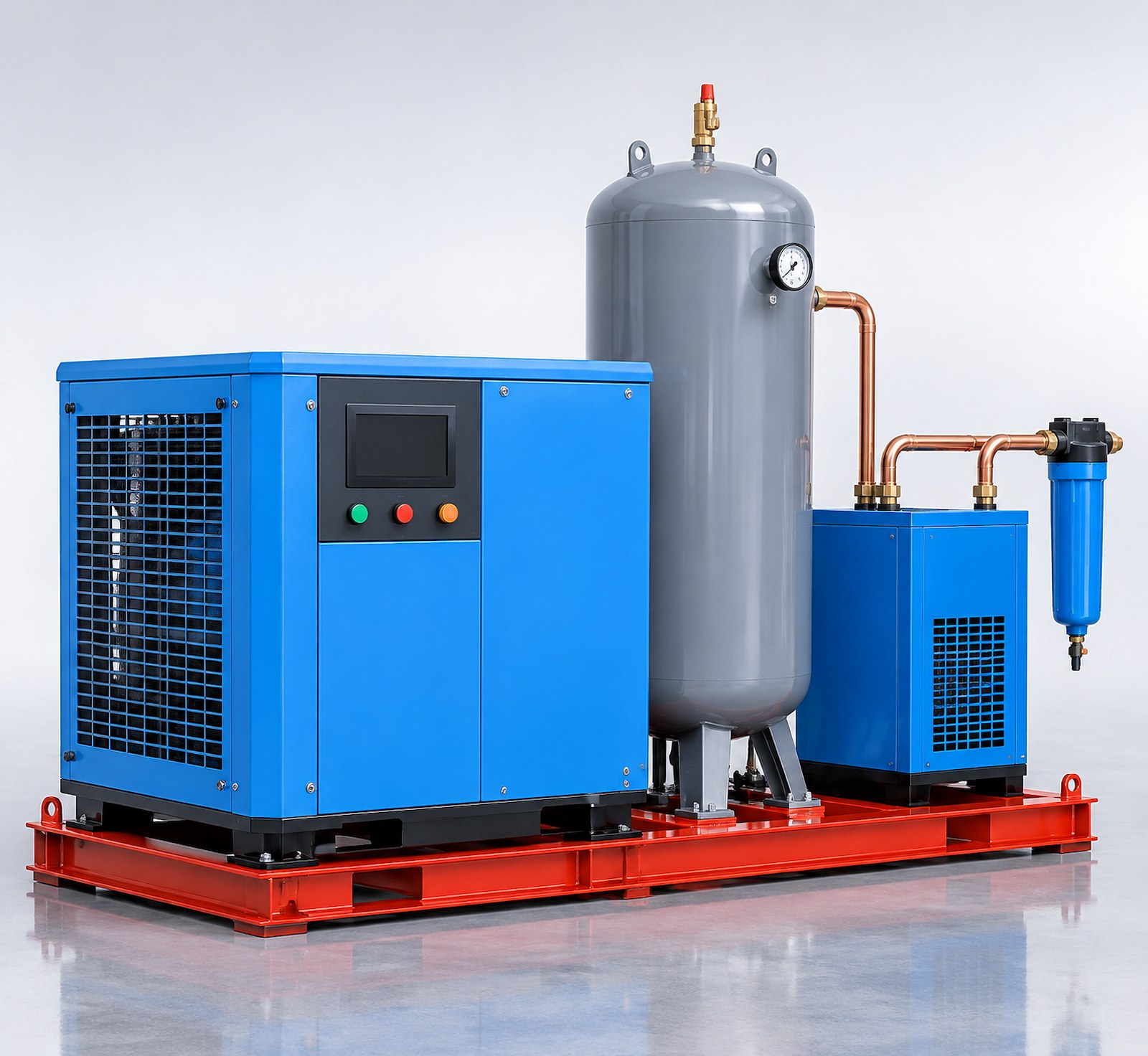
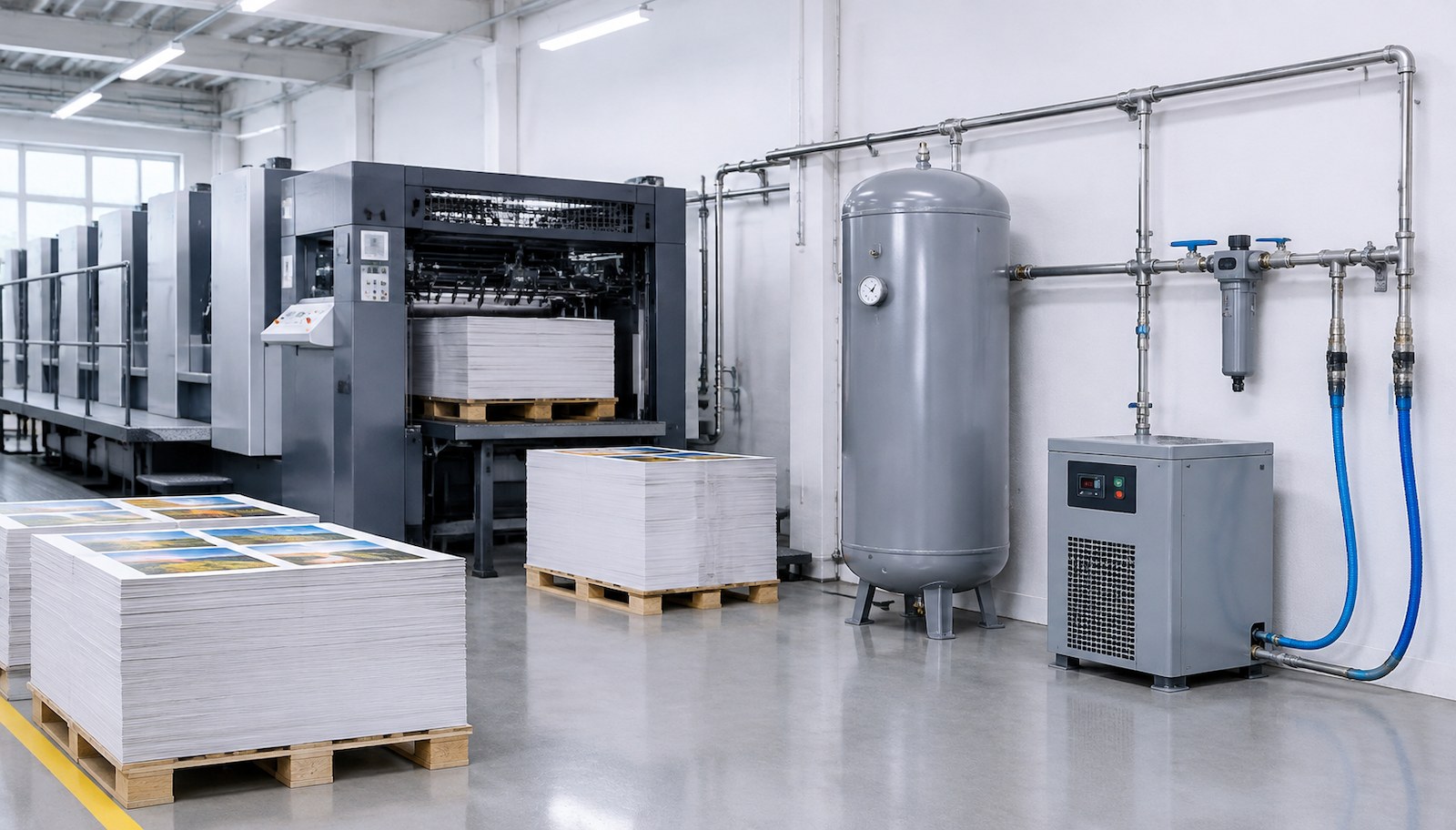
- Build the treatment train in the right order. Receiver tank first (kills pulsation and drops bulk moisture), then refrigerated dryer, then coalescing filter downstream of the dryer — a filter before the dryer is doing work the dryer then undoes. Add a point-of-use filter at the press itself. Ask for the dryer's pressure dew point as a number; a refrigerated dryer normally holds 2 to 10 °C, and that is enough for an indoor press room.
- Check the room before the order. Machine footprint is 890 × 650 × 830 mm at 180 kg net; the packed crate is 905 × 800 × 980 mm at 195 kg gross, which is 0.71 m³ of freight. Measure the aisle, the door and — if it is going upstairs — the floor loading, and confirm you have a pallet truck or forklift at the dock. An air-cooled unit also needs clearance at its cooler: shove it into a corner beside a warm dryer and you have bought yourself a high-discharge-temperature shutdown.
- Plan the noise, because this build has no enclosure. It is declared mute: No and no dB(A) value is published, so treat sound as your engineering item: site it outside the press room wall, isolate it on a rubber pad off the floor structure, and if operators work beside it, get the sound level measured at 1 m before the machine arrives rather than after.
6. Frequently Asked Questions
Add the flow of everything that can fire at once, then multiply by 1.25 to cover loop leakage. A single sheet-fed press feeder plus delivery blow-off generally lands inside the delivery of a 7.5 kW screw machine, and this platform is declared at 0.28 to 1.3 m³/min (9.89 to 45.91 ft³/min). A press plus an inline folder-gluer and a web cleaner can exceed it. The test is not the kW: it is whether the air capacity quoted at your pressure clears your demand total.
No. 100 PSI converts to 6.9 bar, so 100 PSI is a working-pressure statement, not a 10 bar rating — and a machine whose maximum discharge were exactly 100 PSI would have no margin left after the dryer, filter and hose losses. Because maximum working pressure is not declared for this build, ask for two numbers separately: the machine's maximum discharge pressure and the regulated pressure delivered at the press. Print feeders and air knives are normally content in the 6 to 8 bar region, so a 10 bar-capable machine regulated down to about 7 bar is the safe specification.
Only if the air is delivered unfiltered. Lubricated means oil-injected: oil seals, cools and lubricates the airend, and a fraction of it leaves with the air as aerosol and vapour. On paper that shows up as oil bleed around halftone dots, set-off in the stack and ghosting; on a hot-melt head it changes tack. The fix is specified, not accepted: a coalescing point-of-use filter downstream of the dryer, with the element on a replacement interval. Where a job cannot accept any hydrocarbon — food and pharmaceutical packaging, some security work — specify an oil-free machine instead of filtering harder.
For print duty, a dryer is not optional. A receiver tank drops bulk liquid water by cooling the air as it sits, but the air leaving it is still saturated at tank temperature; that water then condenses again at the coldest point of your pipe loop, which is usually above the press. A refrigerated dryer holds a pressure dew point of roughly 2 to 10 °C, which suits an indoor press room. The scope of this build is declared as compressor only, so specify the dryer explicitly — sized to the compressor's full delivery at your ambient temperature.
Do not assume so. This machine is declared mute: No, meaning no acoustic enclosure is fitted, and no sound level in dB(A) is published for it. Treat that as a real cost line: site the unit in its own room or behind a partition, mount it on anti-vibration pads isolated from the floor structure, and if an operator works within a few metres of it all day, require a measured dB(A) at 1 m before the order rather than after.
The machine measures 890 × 650 × 830 mm and weighs 180 kg net, so a standard single door and a clear route will take it, but the move itself needs a trolley or pallet truck — this is not a carry. Inbound it arrives as a single item in a 905 × 800 × 980 mm crate at 195 kg gross, which is 0.71 m³ of freight volume for your quote. Leave clearance at the cooler and at the intake as well as around the frame, because an air-cooled machine starved of intake air trips on discharge temperature.
7. Summary, Ownership Cost, and How to Order a Built-to-Order Set
A 7.5 kW oil-injected, air-cooled rotary screw compressor is the right class of machine for a print shop whose demand runs continuously through the shift and whose air quality is controlled by filtration rather than by luck. The declared specification to buy against is: air capacity 0.28 to 1.3 m³/min, 380 V or 220 V, core components PLC, pump and gear, footprint 890 × 650 × 830 mm, 180 kg net, 1-year warranty, machinery test report and video outgoing inspection provided. Four items must be answered in writing before you release an order: maximum working pressure, the air-capacity figure at that pressure, the dryer and filtration scope, and the sound level in dB(A).
On price — what actually drives it. Anyone asking how much an air compressor costs is usually comparing the wrong numbers. For a 7.5 kW screw machine the purchase price is a minority of what you will pay: at a continuous 7.5 kW draw, annual energy is 7.5 × running hours × your tariff. Worked as arithmetic only, 4,000 running hours at a tariff of \$0.15/kWh is 4,500 kWh, which is \$675 for one year — substitute your own hours and rate, and you will see why the machine that is 20 percent more efficient beats the machine that is 10 percent cheaper. The other three cost lines on a print job are the ones buyers forget: filtration elements and oil service, the dryer, and whatever a single scrapped run costs you when damp, oily air reaches the sheet.
Tell us the press and finishing equipment you run, how many fire together, your working pressure at the nozzle and your mains voltage. The 7.5 kW platform is built to order — configuration, colour, voltage and the dryer and filtration scope — so you receive a specification for your print shop rather than a catalogue line, with a machinery test report and video inspection before shipment.
- Air Screw Compressor Industrial 7.5 kW / 10 HP With Dryer and Tank — the packaged-set specification guide for the same platform.
- Energy-Saving Tips for Air Compressor Users — where the electricity in a print-shop air system actually goes.
- How to Prevent Air Compressor Overheating — cooler fouling in dusty press rooms, and the cleaning interval.
where to buy industrial air compressors
where to buy air compressors
Related Article