what is compressed air

What Is Compressed Air? The Energy Store, the Contaminants It Carries and the Machine That Makes It
Compressed air is ordinary atmospheric air forced into a smaller volume so that it carries usable energy. That is the whole definition, and it explains why factories run on it: air is free, it can be piped, it stores in a receiver, and it releases that energy on demand through a valve. What nobody mentions in the same breath is that compressing it also concentrates everything already floating in it, plus the heat and the lubricant the machine adds on the way.
This page answers what is compressed air in the order a buyer has to use it: what the substance is, what arrives with it, how a machine produces it, and what to have in writing before you commit. The worked example is a field machine rather than a workshop one, the FGMI diesel Small Portable Screw air Compressor 6/8 Mobile Pneumatic Stone Drilling Compressor Machine, because a towable diesel unit makes the energy story visible: an engine drives the airend, and there is no mains power to hide behind.
The Physical Idea in Three Sentences
- Compression stores energy in a volume of gas. Push a given quantity of air into a smaller space and its pressure rises. That pressure difference is what moves a cylinder, spins a tool or holds a valve shut once you let the air expand again.
- The work shows up as heat. Compressing a gas raises its temperature, which is why every screw machine needs cooling, why the airend has its own jacket and why an air-cooled aftercooler sits at the discharge.
- Ambient air is the feedstock, and it is not clean. Whatever was suspended or dissolved in the outside air goes into the compressor with it, and compression makes it more concentrated per unit volume, not less.
That third point is the one with commercial consequences. A shop that treats compressed air as a utility, the way it treats mains electricity, ends up with oil in the paint line and water in the weld. Compressed air is a manufactured product, and like any product it has a specification.
What Arrives With the Air
- Water vapour. Outside air always carries moisture. Compressing it raises the dew point far above the pipe temperature, so the water condenses downstream and travels the line looking for the lowest point, which is usually your equipment.
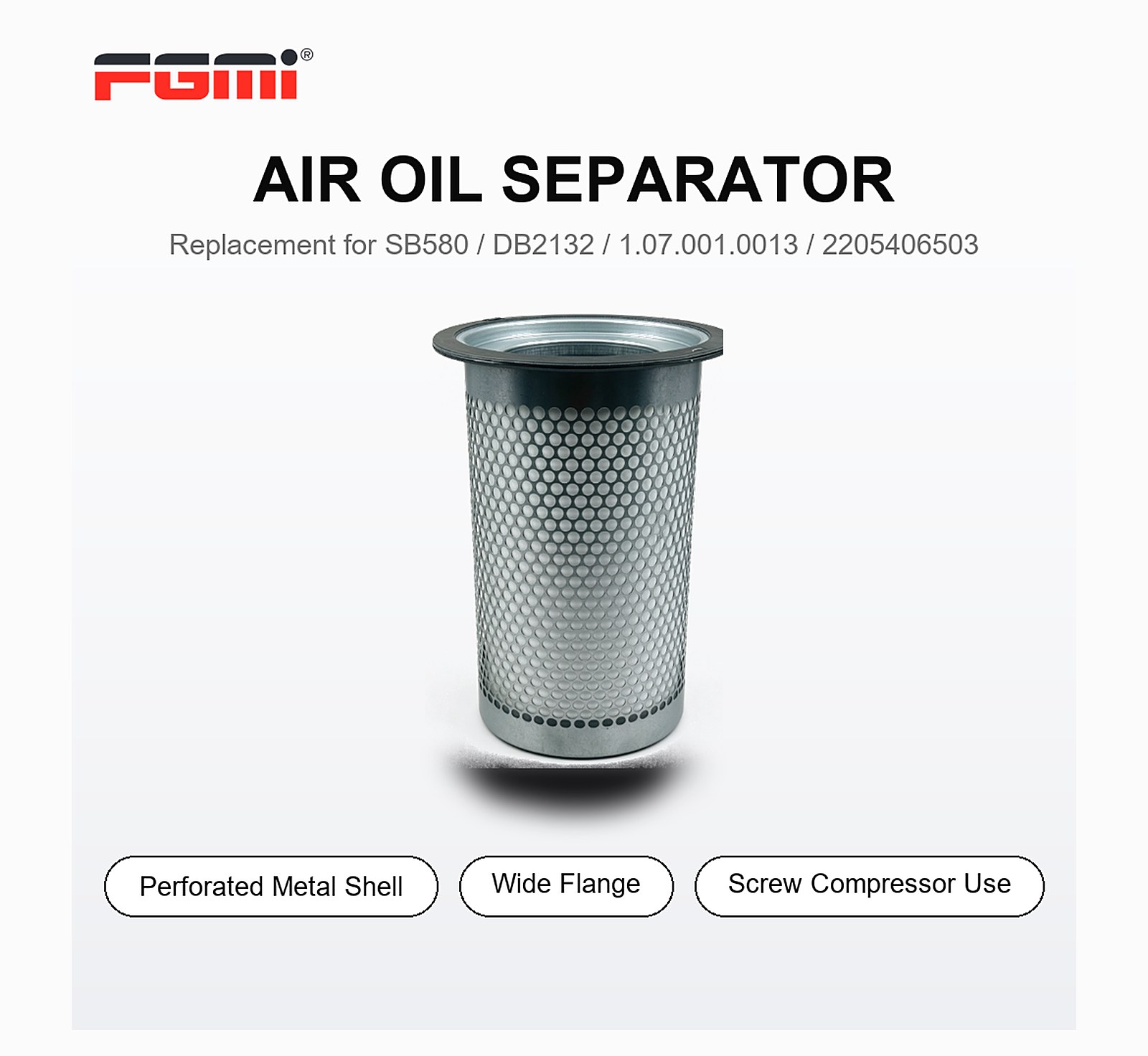
- Oil aerosol and oil vapour. In an oil injected screw machine, oil is deliberately present in the airend to seal, cool and lubricate. A fraction of it leaves with the air as a very fine mist, and the air oil separator is what recovers most of it.
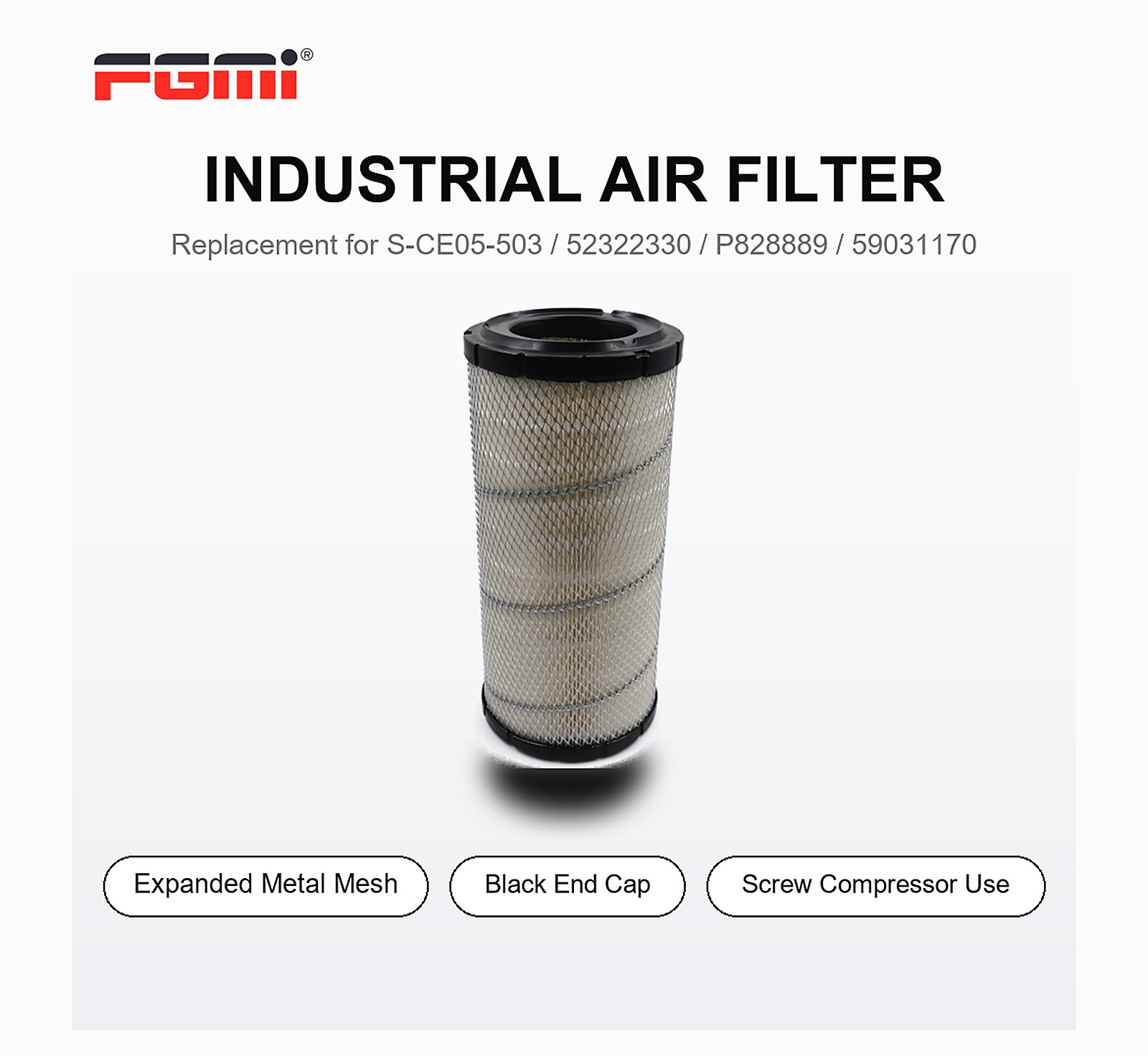
- Solid particulate. Dust, soot and wear particles enter with the intake air. The intake element catches most of it, and what it lets through ends up on the airend surfaces and in the delivered air.
- Heat. Discharge temperature is a working figure, not a curiosity. It decides whether the dryer downstream can do its job and how fast the oil ages.
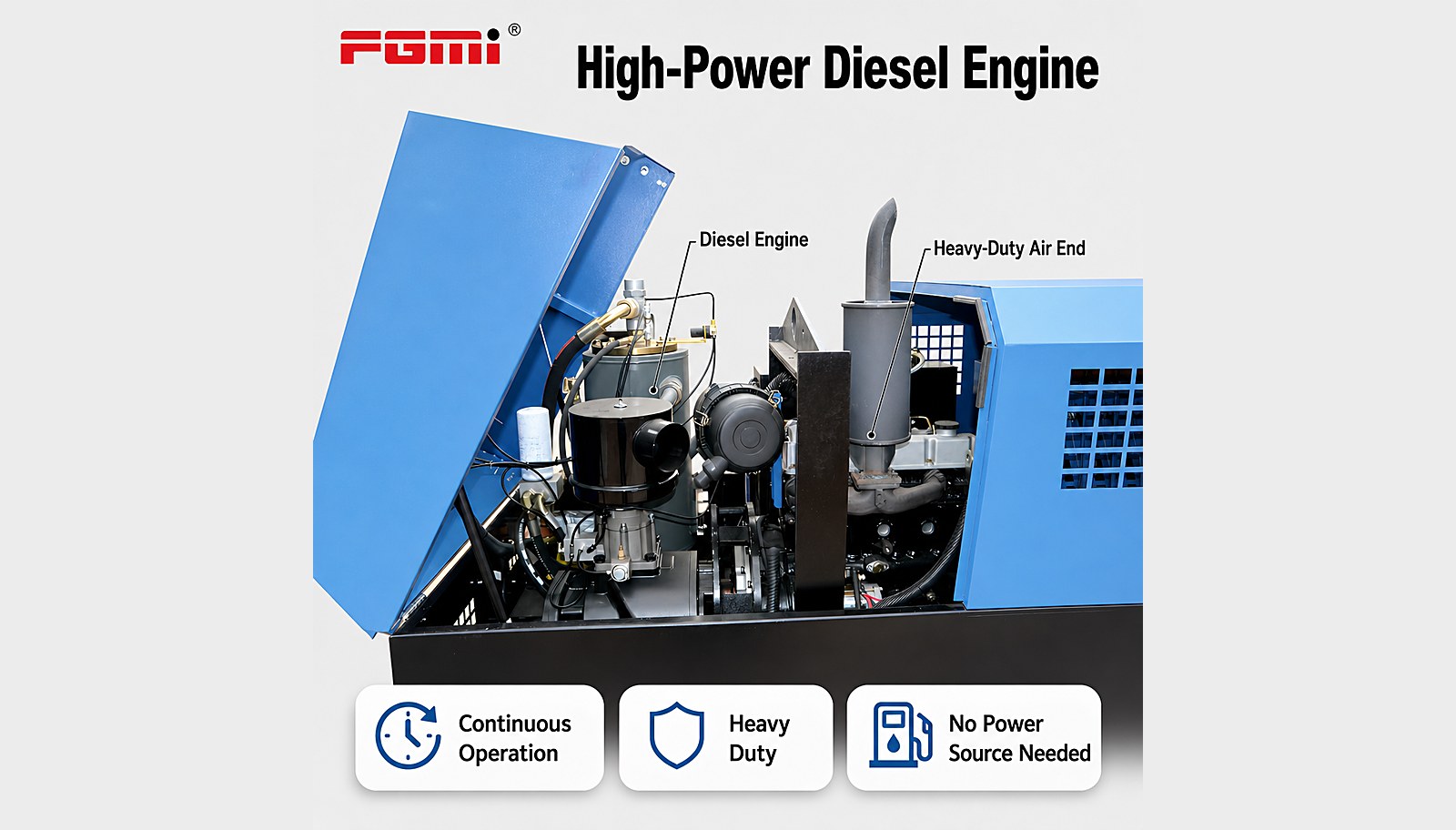
The photograph above is the inside of a towable unit with the canopy open: the diesel engine on one side, the heavy-duty airend on the other, coupled to transmit that engine output into the compression element. Two of the four contaminants above are introduced by that drivetrain itself, and the other two arrive through the intake.
How a Machine Actually Makes It
- Intake. Air is drawn through an intake filter element, which is the first line of defence and the cheapest component in the whole air quality chain.
- Compression. In a rotary screw machine two meshing rotors trap air in progressively smaller spaces, so pressure builds continuously rather than in pulses. The listing used here is described as a screw machine with a heavy-duty air end.
- Cooling and separation. Oil or jacket cooling removes the heat of compression, and in an oil injected machine the separator recovers the oil so it returns to the sump instead of going into your plant.
- Storage and delivery. A receiver smooths the demand peaks so the machine can unload instead of stop-starting, and the treatment train after it sets the air quality the equipment actually sees.
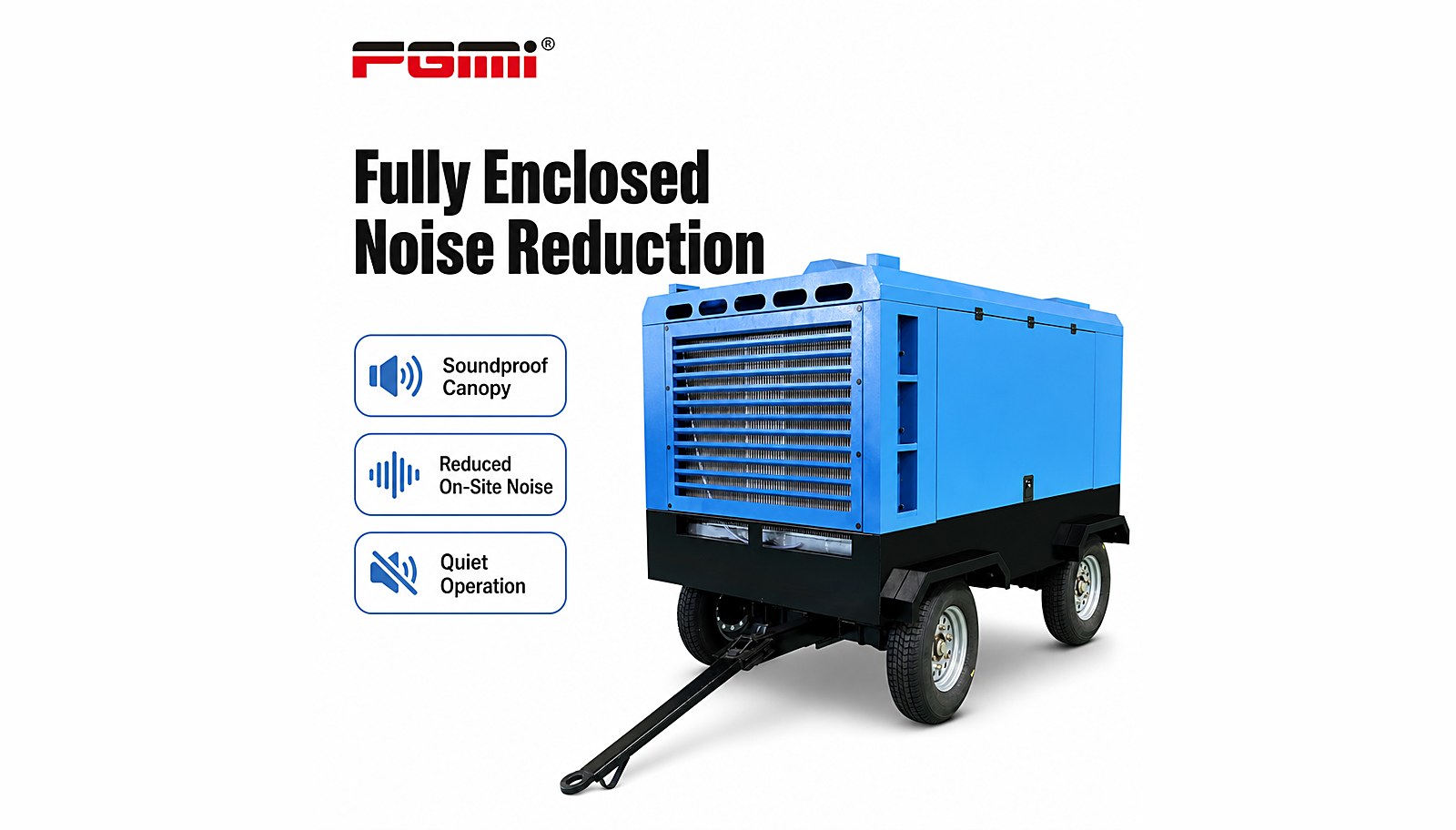
Where a workshop compressor depends on a three phase supply, a field machine carries its own prime mover. The listing used here is trailer mounted with a fully enclosed canopy, and the shipping and trade blocks give a minimum order of one unit, so the same air quality logic applies to a drilling rig parked on a hillside with no mains within reach.
The Three Numbers That Define a Supply
Every compressed air supply is described by the same three figures, and a quotation that gives only one of them is not a specification.
- Delivered volume in cubic metres per minute or cubic feet per minute, measured at the discharge. This is what your tools consume, and on a drilling job it is what the drill and the blast hose eat continuously.
- Working pressure in bar, which on a drilling or blasting application is not negotiable downward; the machine has to hold it while the demand is open.
- Duty and duration which decides whether the machine can run at full load for a whole shift or has to rest, and on a diesel field unit how much fuel and how much cooling it needs to keep going.
Treatment figures belong on the same sheet: pressure dew point after the dryer, filtration grade, and residual oil content in the delivered air. Without those three the phrase compressed air describes a pressure, not a quality.
The Specification Sheet for the Worked Example
The right hand column states where each value came from. Anything reading Not published is genuinely absent from the listing used here and has deliberately not been filled with a typical figure.
| Specification line | Value | Source of this line |
|---|---|---|
| Product | FGMI diesel Small Portable Screw air Compressor 6/8 Mobile Pneumatic Stone Drilling Compressor Machine | Listing title, copied verbatim |
| Model designation on the machine | SNCY10-18 | Product photograph (lettering on the canopy) |
| Configuration | Trailer mounted, fully enclosed canopy, tow bar | Listing title and product photographs |
| Prime mover | Diesel engine driving the screw airend | Listing title, plus Core Components attribute |
| Core components | Engine and Motor | Listing attributes |
| Colour | Blue | Listing attributes |
| Weight | 1000 kg | Listing attributes |
| Free air delivery | Not published | Not declared on the listing |
| Working pressure | Not published | Not declared on the listing |
| Air receiver volume | Not published | Not declared on the listing |
| Dryer and filtration fitted | Not published | Not declared on the listing |
| Sound pressure level | Not published | Not declared, although the canopy is described in the photographs as a soundproof enclosure |
| Fuel consumption and tank size | Not published | Not declared on the listing |
| Packed dimensions and shipping weight | Not published | Not declared on the listing |
| Warranty | 1.5 year | Listing attributes |
| Unique selling point | High load Moment | Listing attributes, copied verbatim |
| Pre-shipment documentation | Video outgoing inspection provided, machinery test report provided | Listing attributes |
| Certificates | Three certificate records attached to the listing; their titles were not returned in the data pulled for this article | Listing certificate block |
| Minimum order | 1 unit | Listing trade block |
| Lead time | 25 days for 1 unit, 35 days for 10, 45 days for 20 | Listing shipping ladder |
| Customisation | Packaging as wooden carton, name plate by laser carving, logo or pattern by screen printing, and core components, all from a minimum of 1 unit | Listing customisation block |
| Country of origin | China | Listing attributes |
The narrow conclusion: everything that makes this a field machine is declared, and everything that sizes it against a job is not. Ask for free air delivery, working pressure, treatment fitted and the shipping envelope in writing, and treat any answer that repeats the nameplate horsepower as a non-answer.
Frequently Asked Questions
Summary and How to Specify a Supply
Answered properly, what is compressed air is not a definition question at all. It is a question about a manufactured product: what pressure it is at, how much of there is, how hot it is, and what is still floating in it when it reaches the tool.
Before ordering a supply, written against a named machine, get six figures: delivered volume, working pressure, duty rating, the treatment actually fitted, the residual oil content of the delivered air, and the shipping envelope. If a supplier can only give you the model name and the engine marque, you are buying an assumption.
Tell us the equipment, the volume each item consumes, the pressure it must hold, the hours per shift and the site ambient. We will size the machine, state the treatment fitted, and answer residual oil content and the shipping envelope in writing before anything is quoted.
how to adjust air compressor pressure switch
what type of oil does an air compressor take
Related Article