what is a 2 stage air compressor

What Is a 2 Stage Air Compressor, and What Changes for the Parts You Buy
A two stage air compressor compresses the air in two steps instead of one, letting it cool between them. The reason is thermodynamic rather than marketing: it is cheaper and cooler to raise pressure in two bites than in one, and the second bite starts from a denser volume of air.
The practical consequence for a buyer is easy to miss. Stage count decides how the machine is built and how hot it runs, but the component you actually reorder is usually the air filter on the intake, and its size follows the volume of air moving through the machine rather than the number of stages. Two worked examples below, the FGMI C32170 SAV350 CF18190 Air Filter for Air Compressor OD310 H520mm Screw Compressor Replacement Parts and the FGMI C1368 SA6620 98262205 Air Filter for Air Compressor OD130 H120mm Screw Compressor Replacement Parts.
Two Stages, Explained Without the Formula
- First stage. Atmospheric air is drawn in through the intake filter and compressed to an intermediate pressure, typically well short of the final delivery pressure.
- Intercooling. That air then passes through a cooler before the second stage, shedding much of the heat generated by the first compression.
- Second stage. The cooler, denser air is compressed again up to the delivery pressure, and the receiver takes it from there.
A single stage machine does the whole rise in one event. Simple, robust, and limited: push the ratio high enough in one go and the discharge temperature becomes the constraint long before the strength of the parts is.
Why the Split Is Made
- Temperature is the primary reason. Cooling between stages keeps each compression closer to an even-temperature process, which is why a two stage piston machine can hold a higher delivery pressure while running cooler than a single stage of the same bore.
- Efficiency follows, because less of the input work is wasted expanding hot gas.
- Displacement utilisation improves too: the second stage handles a smaller volume at a higher pressure, so the low pressure cylinder can be large without the high pressure cylinder being oversized with it.
The cost of a two stage build is real: more parts, an intercooler, more valves, and generally more weight. That trade is worth making at higher delivery pressures and marginal at the low pressures where a single stage is already comfortable.
Where a Rotary Screw Machine Sits Instead
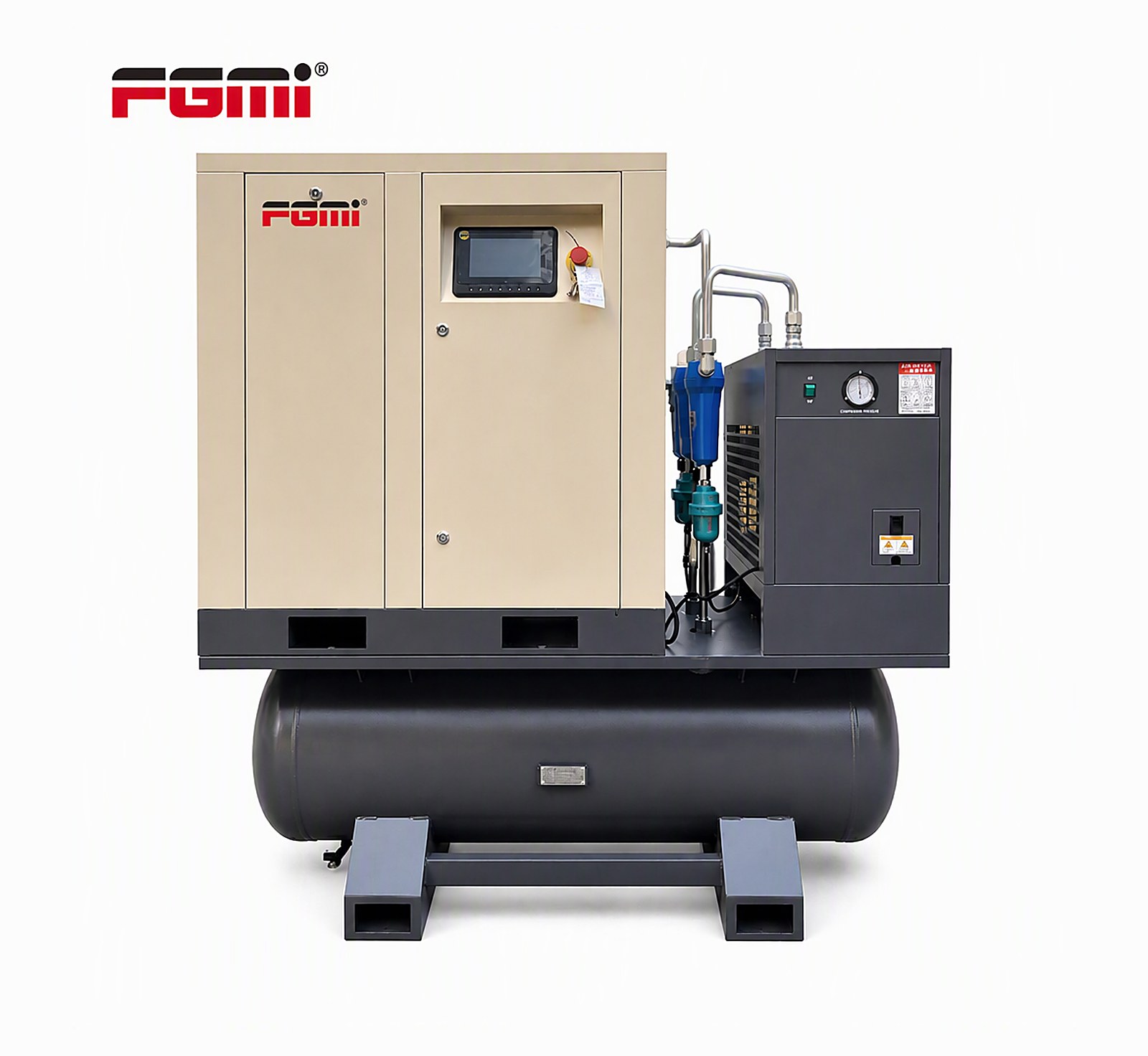
A rotary screw compressor does not have pistons or a two stroke cycle. Two meshing rotors trap air in a housing and carry it through a shrinking volume, so the pressure rise is continuous rather than in pulses. Some screw airends are built with two compression stages in one housing to gain the same interstage advantage; many are single stage.
This is the point where a specification sheet earns its keep. Nothing in a photograph or a model code tells you whether a screw airend is single or two stage, so if the distinction matters to your duty, the stage count has to be stated on the data sheet. Neither listing used as a worked example on this page publishes a stage count.
The Part That Does Not Change: the Intake Element
Whatever the compression arrangement, the machine swallows ambient air, and that air arrives loaded with dust. The intake element is the component that decides how much of it reaches the compression chamber, and its physical size follows the volume of air the machine moves per minute.
- A larger element does not mean a better filter. It means a machine with a bigger appetite, and matching one to the other is what keeps the initial pressure drop where the designer put it.
- An undersized element costs energy and life. Higher face velocity pushes the clean differential up immediately and loads the media faster, so the service interval shortens before the machine reaches full flow.
- Dimensions, not part numbers, protect you. Cross reference lists span several manufacturers, and only the outer diameter, the height and the end form confirm that the element fits the housing in front of you.
Two Real Elements, Side by Side
Two elements from the same range, roughly eight times apart in the volume they serve, make the point better than a description. Anything reading Not published is not declared on either listing and has not been filled in.
| Specification line | Element A, OD310 x H520 | Element B, OD130 x H120 | Source |
|---|---|---|---|
| Listing title | FGMI C32170 SAV350 CF18190 Air Filter for Air Compressor OD310 H520mm Screw Compressor Replacement Parts | FGMI C1368 SA6620 98262205 Air Filter for Air Compressor OD130 H120mm Screw Compressor Replacement Parts | Listing titles, verbatim |
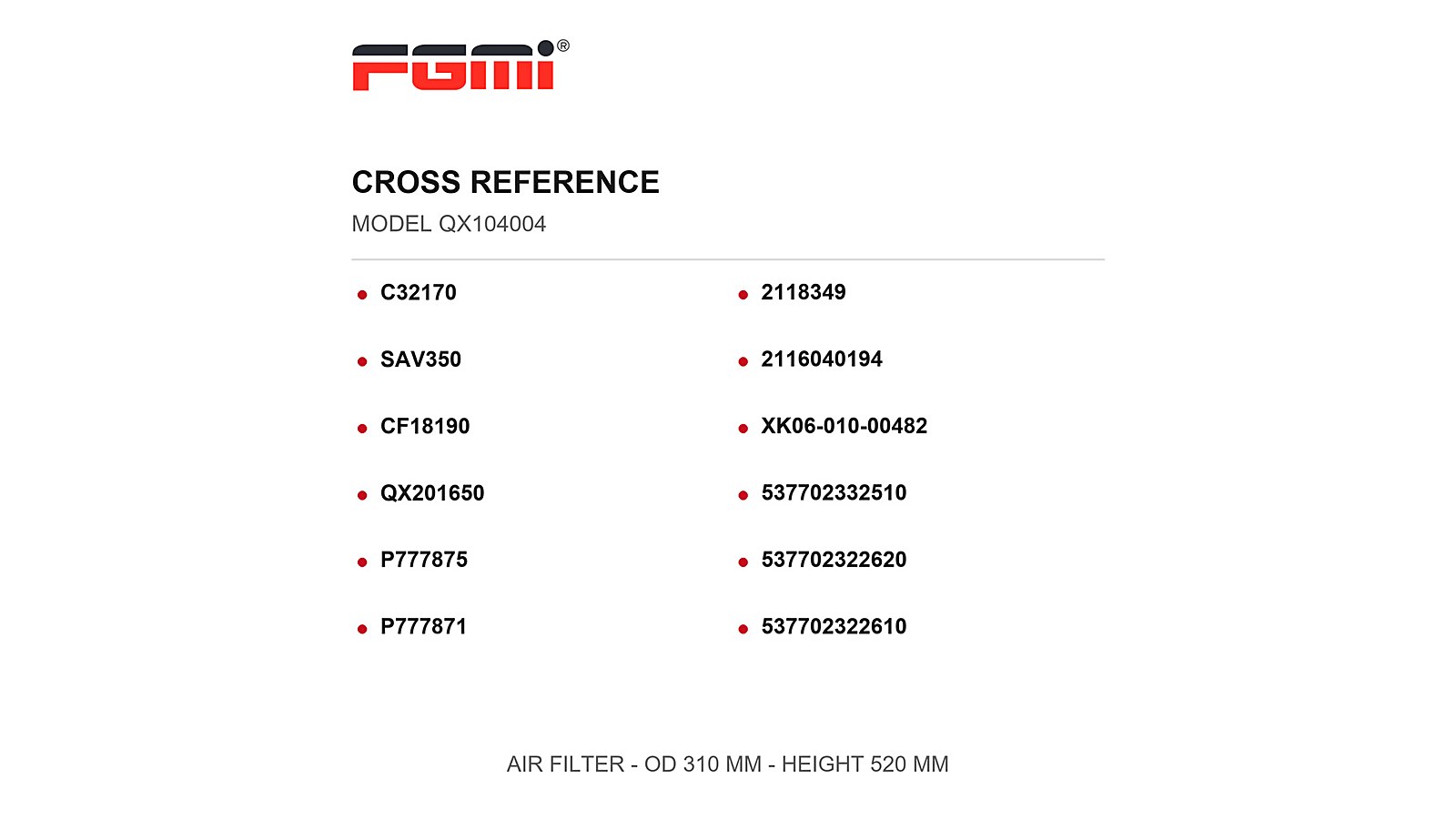
| Outer diameter | 310 mm | 130 mm | Listing titles; the 310 mm figure is repeated on the product photograph |
| Overall height | 520 mm | 120 mm | Listing titles; the 520 mm figure is repeated on the product photograph |
| Type | Air Filter | Air Filter | Listing attributes |
| Materials named | Plastic, Metal, Aluminum, Filter Paper | Aluminum, Metal, Plastic, Stainless Steel | Listing attributes |
| Cross references | C32170, SAV350 and CF18190 from the title; the photograph adds QX104004, QX201650, P777875, P777871, 2118349, 2116040194, XK06-010-00482 and three 53770 numbers | C1368, SA6620 and 98262205 from the title | Listing titles and, for the first element, its product photograph |
| Compression stage count of the machine it fits | Not published | Not published | Neither listing declares a stage count |
| Filtration efficiency or micron rating | Not published | Not published | Not declared on either listing |
| Initial pressure drop | Not published | Not published | Not declared on either listing |
| Dust holding capacity | Not published | Not published | Not declared on either listing |
| Recommended service life | 3,000 to 4,000 hours under normal conditions, with the listing stating that life depends heavily on the operating environment | same wording as the left column | Listing FAQ on both listings |
| Certificates | ISO9001 and CE named in the attributes, plus three certificate records attached | ISO9001 named in the attributes, plus three certificate records attached | Listing attributes and certificate block |
| Colour | Not declared | Brown | Listing attributes |
| Minimum order | 1 pc in the attributes and 1 in the trade block | 1 pc in the attributes and 1 in the trade block | Listing attributes and trade block |
| Delivery | 3 to 7 days in the attributes; the shipping ladder gives 7 days for a quantity of 10 | 3 to 7 days in the attributes; the shipping ladder gives 7 days for a quantity of 10 | Listing attributes and shipping block |
| Packed size and weight | 35 x 35 x 60 cm, 7.3 kg | 18 x 18 x 16 cm, 0.55 kg | Listing shipping block |
| After-sales and origin | Online support, China | Online support, China | Listing attributes |
Note also what neither listing gives, because it is the question this page started with: no stage count is declared for either element or for any machine it fits. If two stage duty matters to your selection, it is a data sheet line, and it is not something the intake element can tell you.
Frequently Asked Questions
Summary and How to Buy the Right Element
A two stage machine is a thermal answer to a compression problem, and a rotary screw airend is a different answer to the same problem. Which one you have is a line on a data sheet, not something you can infer, and neither of the worked listings publishes it.
What you can control is the intake element. Measure the outer diameter and the height of the part you removed, photograph the end faces, and send those two numbers with the cross references rather than instead of them. Ask for efficiency, initial pressure drop and dust holding against the named element, because on both listings those three lines are simply not there.
Outer diameter, overall height and a picture of the end faces is enough to confirm an element. We will answer filtration grade, initial pressure drop and dust holding against the named part before quoting, and state the machine stage count where the data sheet carries it.
how to adjust air compressor pressure switch
Related Article