Compressed Air Leaks: How Much Are They Costing You?
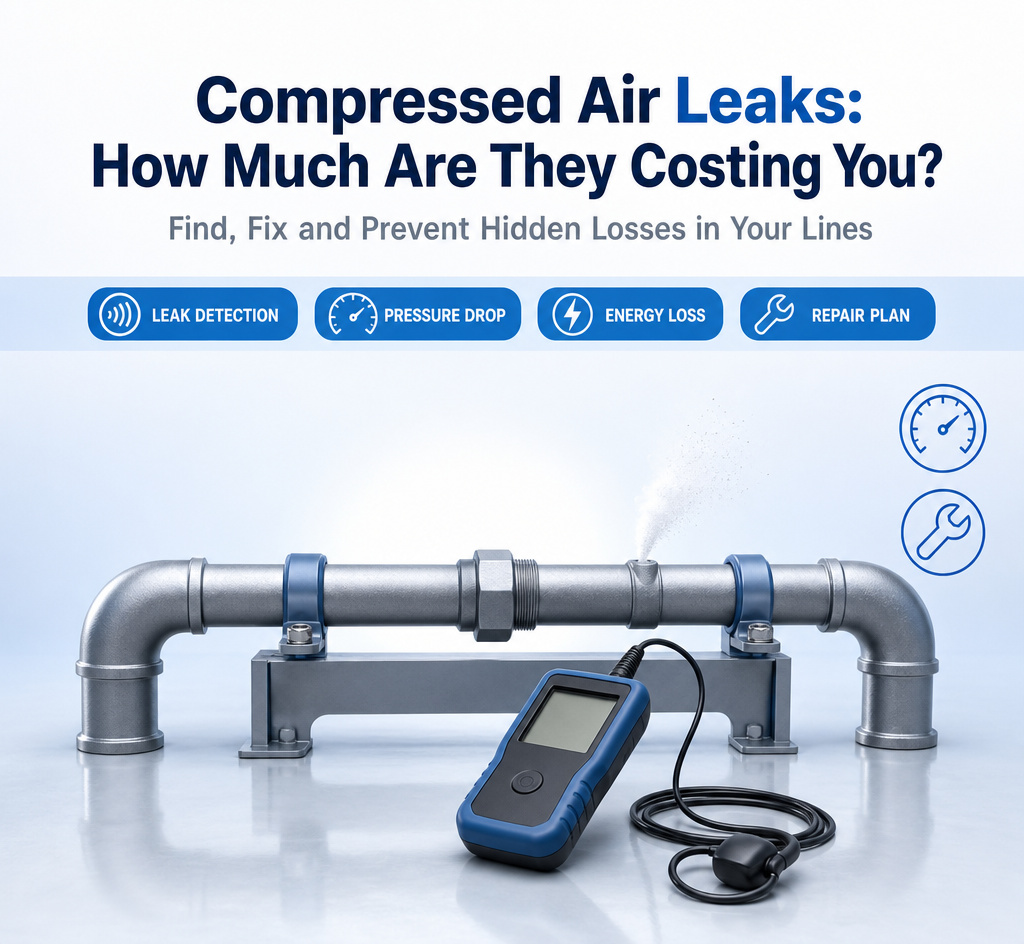
Compressed Air Leaks: How Much Are They Costing You?
1. Introduction
Compressed air is widely known as one of the most expensive utilities in industrial facilities, yet many plant operators overlook compressed air leaks. Unnoticed air leaks constantly drain your system, forcing your air compressor to run longer and cycle more frequently to maintain target pressure. Many factories lose 20% to 30% of their total compressed air output through leaks, and some poorly maintained systems suffer even higher losses. This guide explains how air leaks create financial losses, how to estimate the real cost, and practical ways to locate and fix leaks in your pneumatic network.
2. What Are Compressed Air Leaks?
A compressed air leak happens when pressurized air escapes unintentionally from gaps in your air system. These openings can form over time due to vibration, aging seals, improper installation, corrosion, or physical damage. Leaks release air continuously even when no pneumatic tools are running. The compressor will keep starting up to compensate for lost pressure, consuming extra energy without delivering any productive work. Small leaks add up quickly; dozens of tiny leaks across a piping network can equal the air consumption of an active production workstation.
4. How to Calculate How Much Air Leaks Cost Your Facility
You can estimate leak cost by measuring total air loss and combining it with local electricity pricing. The basic approach is to shut down all air-consuming tools and record how much the compressor loads and unloads during idle periods. The percentage of runtime during idle mode represents your leak percentage.
Once you know the leak percentage, multiply it by your compressor power consumption, operating hours, and electricity cost per kWh. This gives you the annual energy waste from leaks. Many industrial audits show that fixing leaks delivers fast ROI, often recovering inspection and repair costs within a few months.
5. Most Common Places to Find Compressed Air Leaks
- Quick connect fittings, couplings and hose connections
- Valve stems, seals and solenoid valves
- Threaded pipe joints and flanges
- Condensate drain points and automatic drain valves
- Air hose cracks, abrasion damage and worn rubber sections
- Filter, dryer and regulator connection points
Leaks often occur in areas with constant vibration, repeated tool swapping, or poor original installation. Hard-to-reach overhead piping is frequently overlooked during routine inspections.
6. Methods for Air Leak Detection
The soap bubble test is the low-cost classic method. Apply diluted soap water on suspected joints; bubbles will form where air escapes. This works well for on-site routine checks. For larger industrial sites, ultrasonic leak detectors are widely used. These devices capture high-frequency sound from escaping compressed air, enabling technicians to find leaks even in noisy factory environments.
Thermal imaging and flow monitoring can also help quantify total air loss across the whole system. Regular leak audits, scheduled quarterly or annually, help catch new leaks before they accumulate.
7. Best Practices to Repair and Prevent Air Leaks
Replace worn hoses, cracked seals and defective couplings immediately. Avoid over-tightening threaded connections, which can crack fittings and create new leaks. Use proper sealant for threaded joints. Train maintenance staff to inspect connections during routine equipment service.
System pressure management also helps reduce leak loss. Operating at unnecessarily high pressure makes every leak waste more air. Reduce the working pressure to the minimum level required by your production tools. Combine leak repair with proper filtration and drying, as clean dry air reduces corrosion and seal degradation, slowing the formation of new leaks.
8. Summary
Compressed air leaks represent a continuous, avoidable expense for almost every industrial facility. Beyond wasted electricity, leaks increase maintenance workload, shorten equipment lifespan and create unstable operating pressure that hurts production quality. Regular leak detection and timely repair are among the most cost-effective improvements you can make to your compressed air system. Tracking leak volume and calculating annual losses helps justify maintenance budgets and deliver measurable savings for your operation.
Inline Air Filters: Why Your System Needs Them
What Does an Air Dryer Do in a Compressor System?
Related Article