Primary vs. Secondary Air Filters: What's the Difference?
Primary vs. Secondary Air Filters: What's the Difference?
Introduction
Industrial air intake systems for air compressors, blowers and heavy machinery often use dual-stage air filtration: primary air filters and secondary air filters. Many buyers confuse these two elements or treat them as interchangeable parts. Each filter has a unique filtration grade, service duty and role within the air intake path. Understanding primary vs secondary air filters helps protect compressor rotors, bearings and internal components from dust, sand and airborne debris, while extending equipment service life.
This guide explains the function, design and maintenance rules of primary and secondary air filters, highlighting their differences and how they work as a matched filtration system for compressed air equipment.
What Is a Primary Air Filter?
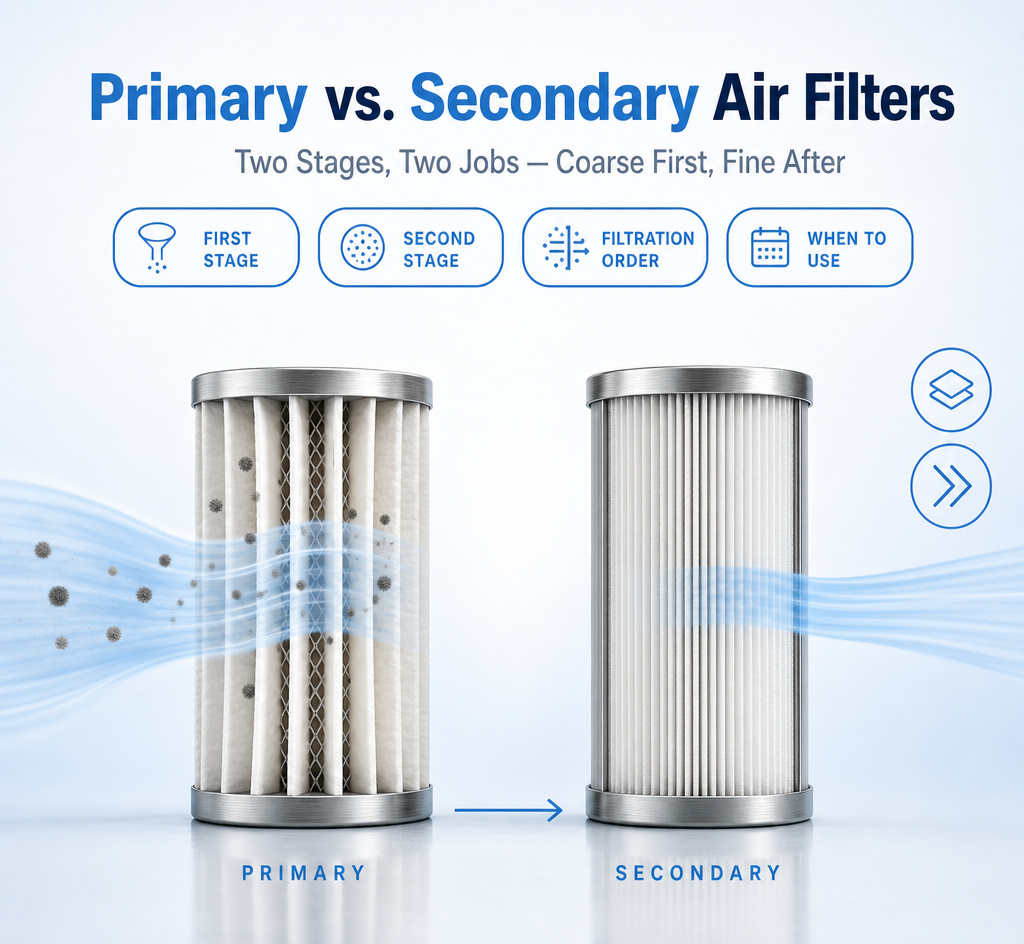
The primary air filter is the first line of defense in the air intake system. It is exposed directly to incoming raw air and captures large, coarse contaminants before air moves deeper into the system. Primary filter media is designed for high dust holding capacity rather than ultra-fine particle removal.
Common captured particles include dirt, sand, plant debris, insects and large dust agglomerates. Because it handles the bulk of airborne solids, the primary filter accumulates contaminants quickly and will show visible clogging in dusty operating environments. It protects the secondary filter from heavy dust loading and premature blockage.
Primary filters are usually larger in size, with pleated media built for high airflow. In heavily dusty workshops, construction sites or mining environments, primary filters require more frequent inspection and replacement.
What Is a Secondary Air Filter?
The secondary air filter, also known as the safety filter, sits behind the primary filter. It acts as a backup high-efficiency barrier. Its job is to trap fine particulate matter that passes through the primary filter. It also serves as emergency protection if the primary filter tears, leaks or is incorrectly installed.
Secondary filter media has finer pores and higher filtration efficiency for small dust particles. Since most large contaminants are already removed by the primary filter, the secondary filter loads much slower and has a longer service interval. It prevents fine dust from reaching the compressor pump, rotor or engine cylinders, which can cause abrasive wear and costly internal damage.
Secondary filters are often smaller and more compact. They are not designed to handle heavy dust loads, and they will clog rapidly if the primary filter fails or is removed during operation.
Key Differences Between Primary and Secondary Air Filters
- Position: Primary filter = first intake stage. Secondary filter = backup inner stage after primary.
- Filtration Target: Primary captures large debris; secondary captures fine dust particles.
- Dust Holding Capacity: Primary has high dust capacity; secondary has low dust capacity.
- Replacement Frequency: Primary replaced more often; secondary replaced less frequently.
- Core Role: Primary reduces bulk contamination; secondary provides safety protection for core machinery.
- Consequence of failure: Damaged primary filter overloads secondary filter; damaged secondary filter lets fine dust directly damage compressor internals.
How Primary and Secondary Filters Work Together
Dual-stage filtration creates a layered protection system. Raw air enters the filter housing and first passes through the primary filter. Most coarse particles are trapped here. The partially cleaned air then flows into the secondary filter for fine particle removal before entering the air compressor.
This two-stage design balances airflow performance and filtration efficiency. Using only a single fine filter would create high air resistance and clog very quickly in dusty sites. Using only a coarse primary filter allows fine dust to pass through and wear internal machine components.
Benefits of Dual-Stage Filtration
- Longer service life for the secondary filter
- Stable intake airflow and lower pressure drop
- Reduced abrasive wear on compressor rotors and bearings
- Lower frequency of filter service and maintenance downtime
- Emergency protection if primary filter ruptures
Replacement & Maintenance Best Practices
Inspect the primary filter regularly, especially in dusty working environments. Check for dirt buildup, cracks, loose seals or deformation. Clean or replace the primary filter once pressure drop exceeds the equipment recommended threshold.
Never remove the secondary filter and run the compressor with only the primary filter installed. The secondary filter is a critical safety barrier. When replacing the secondary filter, always check the primary filter at the same time. If the primary filter is damaged, debris may have already contaminated the secondary element, requiring immediate replacement of both.
Always install filters with proper sealing gaskets to prevent unfiltered air bypass. Poor sealing defeats the whole filtration system, allowing dirty air to leak past filter media directly into the compressor.
Common Mistakes When Using Air Filter Sets
- Removing the secondary filter to reduce intake resistance
- Reusing damaged primary filters, which overloads the secondary filter
- Installing filters in reverse order
- Ignoring filter seal inspection, leading to air bypass
- Using mismatched filter elements that do not fit the filter housing
- Delaying replacement after high dust exposure events
Conclusion
Primary and secondary air filters serve separate but complementary roles in air intake filtration. The primary filter handles bulk coarse contaminants and extends the life of the secondary safety filter. The secondary filter provides fine particle capture and emergency protection for your air compressor or blower.
Understanding the difference helps maintenance teams schedule inspections, select matching replacement filter elements and avoid expensive internal equipment damage. Proper dual-stage air filter maintenance reduces downtime, preserves compressor efficiency and maximizes the working life of your pneumatic system.
Air Receiver Tanks: Purpose & Sizing Basics
How to Winterize Your Air Compressor for Cold Seasons
Related Article