HEPA vs. Standard Filters: Key Differences
HEPA vs. Standard Filters: Key Differences
Introduction
When designing or upgrading a compressed air system or air purification setup, choosing the right filter directly impacts air quality, equipment protection and operational cost. Standard filters are widely used for general-duty particle removal, while HEPA filters deliver high-grade fine particle capture for strict contamination control. Many industrial buyers confuse these two filter types and mistakenly pick the wrong one, leading to poor air quality, high pressure drop or unnecessary spending. This article breaks down their core distinctions, performance characteristics and suitable applications for B2B industrial compressed air systems.
What Are Standard Air Filters?
Standard industrial air filters include intake pre-filters, general particulate inline filters and coalescing filters for compressed air. They are built with pleated cellulose, polyester or glass fiber media designed to trap larger particles, dust, liquid aerosols and debris. Standard filters are engineered for high airflow, low pressure drop and heavy dust holding capacity. Their primary goal is to protect air compressors, pneumatic tools and downstream equipment from coarse contaminants. They serve as the first line of filtration in most workshop and factory compressed air circuits.
What Are HEPA Filters?
HEPA stands for High-Efficiency Particulate Air. True HEPA filters must meet strict standards, capturing 99.97% of particles as small as 0.3 microns. HEPA media consists of dense, randomly arranged fine glass fiber mats, formed into deep pleated packs. In compressed air systems, HEPA filters are installed as final stage polishing filters. They target fine particulates, microorganisms and ultra-fine dust that passes through standard filters. HEPA filters are commonly used in food, pharmaceutical, medical, electronics and precision manufacturing environments requiring ultra-clean air.
Core Differences Between HEPA and Standard Filters
Filtration Efficiency & Particle Size
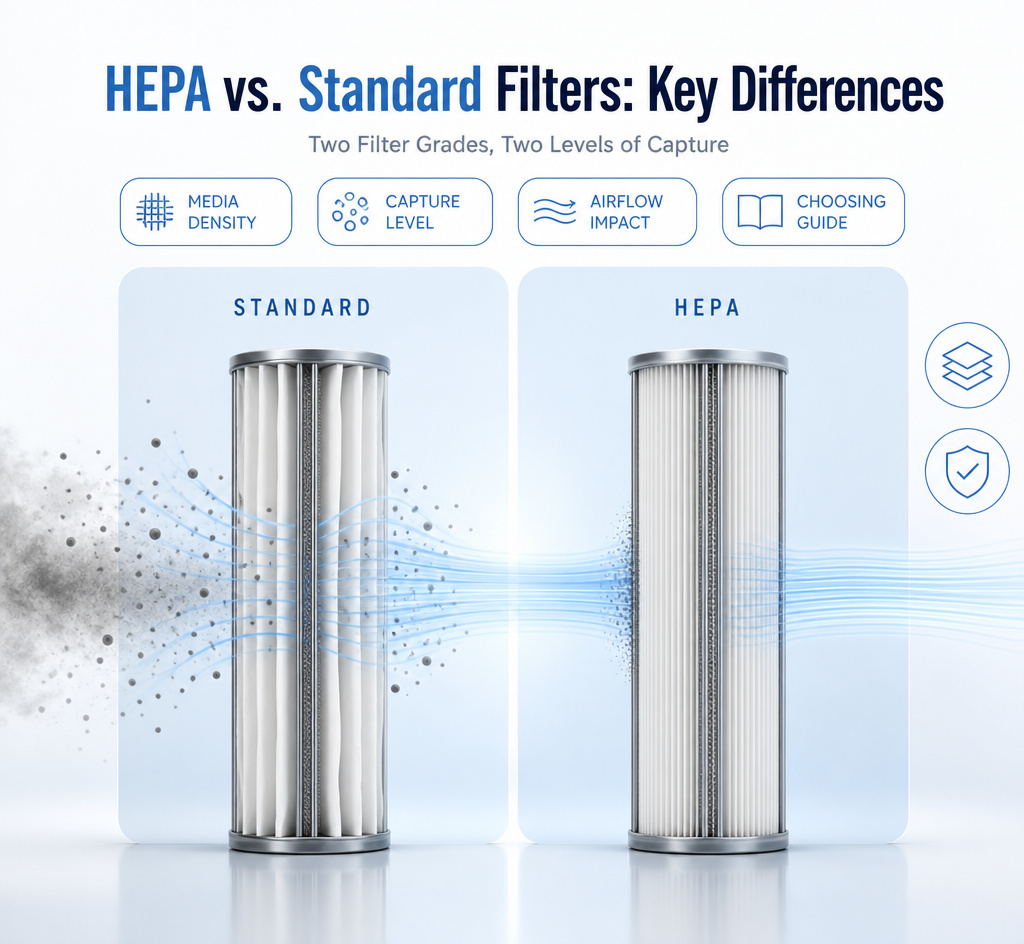
Standard filters excel at capturing large particles, typically 1 micron and above. Many standard inline filters can remove liquid oil aerosols but allow fine submicron particles to pass through. HEPA filters are designed for submicron particles. The 0.3-micron rating is the most penetrating particle size, meaning particles smaller or larger than this threshold are captured at even higher rates. This makes HEPA the ideal choice when product contamination risk must be eliminated.
Airflow Resistance & Pressure Drop
Standard filters have open media structure, so pressure drop remains low even with high air volume. They are suitable for continuous high-flow compressed air main lines. HEPA media is much denser, creating significantly higher pressure drop. This increases energy consumption because the compressor must work harder to maintain system pressure. HEPA filters are not recommended for main trunk lines; they are best used at point-of-use after pre-filtration to reduce loading and energy loss.
Filter Media & Construction
Standard filter media can be cellulose, blended synthetic or simple glass fiber, with relatively large pore sizes. Seals and housings are built for general industrial environments. HEPA filters use ultra-fine borosilicate glass fiber media, tightly pleated. They require robust gaskets and leak-tested housings. Media damage or seal leaks completely ruin HEPA performance, so manufacturing and integrity testing standards are far stricter than standard filters.
Lifespan and Maintenance Requirements
Standard filters generally have longer service life and can hold large volumes of dust and liquid contaminants. Replacement is triggered by differential pressure increase. HEPA filters clog faster, especially if upstream pre-filters are missing or damaged. Heavy dust or oil aerosols quickly saturate HEPA media. HEPA filters also require integrity testing after installation or replacement to verify no bypass leaks, adding extra maintenance steps compared to standard filter elements.
Typical Use Cases for Each Filter Type
Standard filters are the default for general workshops, construction pneumatic tools, general painting, metalworking and main compressed air pipeline protection. They protect compressors, remove bulk condensate and coarse dust at low operating cost. HEPA filters are deployed in point-of-use applications: pharmaceutical processing, food packaging, semiconductor manufacturing, laboratory air, medical equipment and cleanroom environments. In most industrial setups, HEPA filters are never used alone; they are placed downstream of standard pre-filters and coalescing filters to extend HEPA lifespan.
How to Choose Between HEPA and Standard Filters
Start by defining your required air quality class. If your process only needs removal of coarse dust and liquid condensate, standard filters will meet requirements with lower energy and maintenance cost. If your production involves sensitive products, sterile conditions or micro-contamination risk, you will need HEPA as a final polishing stage. Always install standard pre-filters before HEPA to capture oil, water and large particles, preventing rapid HEPA clogging. Budget, airflow demand and acceptable pressure drop are also key factors in your filter selection decision.
Common Misconceptions About HEPA Filters
One common myth is that HEPA filters can remove oil vapors. HEPA captures solid particles and aerosols, but it cannot adsorb oil vapor or gas. Activated carbon filters are required for vapor removal. Another misconception is that HEPA can replace all upstream filtration. Without pre-filters, oil and dust will quickly block HEPA media and cause high pressure loss. Also, not every filter labeled “HEPA-style” meets true HEPA standards. For critical industrial applications, verify independent efficiency testing reports before purchase.
Conclusion
Standard filters and HEPA filters serve different roles in compressed air systems. Standard filters handle bulk contaminants, maintain low pressure drop and protect equipment for general industrial use. HEPA filters deliver ultra-high efficiency removal of submicron particles for high-purity air applications, at the cost of higher pressure drop and stricter maintenance. In most high-grade compressed air systems, they work together: standard filters act as pre-filtration, and HEPA provides final polishing. Understanding these key differences helps industrial buyers select the correct filter combination, balance air quality requirements and control long-term operating expenses.
Energy-Saving Tips for Air Compressor Users
How to Prevent Air Compressor Overheating
Related Article